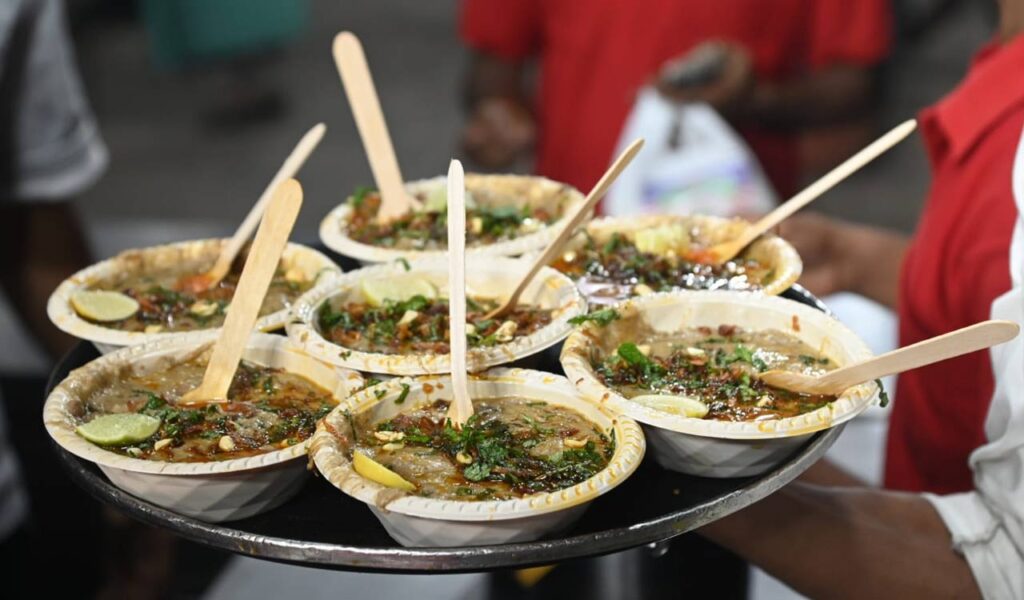
how to make beef haleem for sale in hyderabad
Making beef haleem for commercial sale in Hyderabad requires sourcing quality ingredients in large proportions, slow-cooking the meat with cracked wheat and lentils, and complying with local food safety and business licensing regulations.
Key Ingredients & Authentic Ratio
- The Meat-to-Grain Ratio: Traditional large-scale haleem uses a rich proportion (often maintaining high meat content relative to grains and lentils, roughly matching or exceeding standard commercial ratios where boneless/bone-in beef is thoroughly mashed). [1]
- Base Ingredients: Boneless beef and choice cuts with some fat for flavor, cracked wheat (dalia) or barley, and a mix of lentils (chana dal, masoor dal, moong dal, urad dal). [1, 2]
- Aromatics & Spices: Generous amounts of ginger-garlic paste, fried onions (birista), mint, coriander, green chilies, ghee, and a fine-ground haleem masala (shahi jeera, cardamom, cloves, cinnamon, peppercorns, and rose petals). [1, 2]
Commercial Cooking Process
- Soaking & Boiling: Soak the lentils and broken wheat for several hours, then boil them separately with nuts or oats until completely soft. [1]
- Slow Cooking the Meat: Cook the beef with ginger-garlic paste, fried onion oil, spices, and green chilies until tender. [1, 2]
- The Ghota (Mashing): Combine the cooked beef and the grain-lentil mixture in a large heavy-bottomed vessel (handi). Mash and beat the mixture continuously using a heavy wooden paddle (ghota) over a low flame for hours until it achieves a smooth, thick, and sticky consistency. [1, 2]
- Garnishing: Finish and serve hot topped with pure ghee, fried onions, chopped mint, coriander, and a squeeze of lemon juice. [1]
Watch a visual demonstration of the traditional large-scale mashing and preparation process used for haleem:
‼️ Hyderabadi Haleem Making Process 🔥‼️ . . Do follow …
67K views · 6 months ago

Instagram · HYDERABAD CITY EXPLORE (HCE)
Business & Legal Requirements in Hyderabad
- FSSAI Registration: Obtain a food business license or registration from the Food Safety and Standards Authority of India (FSSAI) for commercial food production.
- GHMC & Health Permits: If setting up a physical stall or eatery, secure a trade license from the Greater Hyderabad Municipal Corporation (GHMC) and ensure local health and hygiene standards are met.
- Sourcing & Hygiene: Establish reliable wholesale contracts for fresh beef and pure ghee, and maintain strict sanitation standards, especially given local regulatory focus on meat quality during peak seasons like Ramadan.
Would you like information on commercial equipment needed for bulk preparation or cost estimation and pricing strategy for selling haleem?
YouTube·Vahchef – VahRehVahHaleem great Hyderabad recipe- The Ultimate Ramadan Specialeven though haleem is all mashed up the quality of meat is very important. and if you can get cena like meat it is even better eve…
5m
InstagramAuthentic Hyderabadi Beef Haleem made the traditional way …Authentic Hyderabadi Beef Haleem made the traditional way 🥘 Prepared by skilled cooks from Hyderabad using the original age-old r…
InstagramFreshly prepared Haleem available 365 in Hyderabad …Hyderabad ki Shaan — Authentic Hyderabadi Haleem! ❤️ Mutton, dal aur wheat ka rich combination, upar se fried onions, lemon aur fr…
Show all
yes
⚙️ Commercial Equipment for Bulk Preparation
Transitioning from home cooking to a commercial setup requires specialized kitchen machinery to manage heavy volumes efficiently. In Hyderabad, standard restaurant portions are processed using the following commercial machinery: [1]
- Commercial Cooking Mixer / Halwa Making Machine: This is the most crucial asset for large-scale operations. Traditional wooden ghota mashing is labor-intensive, so commercial kitchens utilize automatic, heavy-duty planetary or halwa mixers.
- Commercial Spice Pulverizer / Grinder: Achieving the specific, fine consistency for custom Haleem Masala mixes at scale requires a 3 HP to 5 HP semi-automatic grinding machine. This typically costs ₹20,000 to ₹60,000 depending on the production capacity per hour. [1, 2]
- Meat Mincer / Chopper: An industrial-grade meat mincer facilitates uniform breakdown of beef fibers prior to slow cooking. Prices range between ₹25,000 and ₹50,000.
- Heavy Stainless Steel Bhatti Burners: Traditional commercial setups run on high-pressure LPG commercial burners coupled with extra-thick copper or stainless steel handis to prevent the meat from scorching during a 10–12 hour slow simmer.
📊 Cost Estimation & Pricing Strategy
When scaling a beef haleem venture in Hyderabad, managing input costs closely is essential since prices of meat, ghee, and commercial gas cylinders fluctuate heavily. [1, 2, 3]
1. Estimated Cost Breakdown (Per 300g Plate)
Data from Hyderabad’s restaurant sector indicates raw material costs (ingredients and consumables) average roughly ₹0.60 per gram of finished product. [1]
| Cost Category | Estimated Expense (per plate) | Notes / Details |
|---|---|---|
| Raw Materials (COGS) | ₹80 – ₹95 | Includes beef (with choice fats), pure ghee, spices, wheat/lentils, dry fruits. |
| Consumables & Utilities | ₹15 – ₹20 | Commercial LPG cylinders and heavy electricity use for mashing. |
| Packaging & Garnish | ₹10 – ₹15 | Plastic containers/boxes, lemons, fried onions, and mint. |
| Indirect Overhead (Estimated) | ₹30 – ₹45 | Labor, stall/kitchen rent, FSSAI compliance, marketing. |
| Total Production Cost | ~₹135 – ₹175 | Baseline cost before determining target profit margins. |
2. Local Market Pricing Strategy
The Hyderabad market operates under highly competitive pricing tiers: [1]
- Premium Brand Tier: Top-tier chains (like Pista House, Shah Ghouse, or 555) price their standard mutton/beef variations between ₹250 and ₹300 per single serving. [1, 2, 3]
- Mid-Scale / Local Stall Tier: Neighborhood eateries and seasonal pop-up stalls price competitive variants between ₹160 and ₹220 per plate.
3. Pricing Formula
To ensure sustainability against inflation, calculate your target price via a Cost-Plus framework:
\(\text{Selling\ Price}=\frac{\text{Total\ Production\ Cost}}{1-\text{Target\ Gross\ Margin\ Percentage}}\)
[1, 2]
- For example, if your total direct cost is ₹140 and you target a 30% gross profit margin:
\(\text{Selling\ Price}=\frac{140}{1-0.30}=\frac{140}{0.70}=\mathbf{\rupee 200}\) [1]
If you want to map out your initial launch, tell me:
- What is your target daily production volume (e.g., 50 plates vs. 500 plates)?
- Are you opening a physical street stall, cloud kitchen, or supplying wholesale to other restaurants?
- Do you plan to sell exclusively during Ramadan or as a year-round business?
I can structure a customized capital requirement breakdown for your launch.
Gurubhai EquipmentsBest Commercial Food Preparation Equipment in India GuideWhen these jobs are performed entirely by hand, a food business may face slow preparation, inconsistent output, excessive labour d…
The HinduHaleem lovers find hike in price hard to digestCost of the Ramzan delicacy has shot up by ₹40-₹70 Published – April 07, 2022 12:22 am IST – HYDERABAD Syed Mohammed 0 Haleem pric…
The New Indian ExpressHaleem prices hold steady despite soaring ingredient costs3 Mar 2025 — Haleem prices hold steady despite soaring ingredient costs While chicken haleem’s demand has declined, mutton haleem remains popul…
Show all
yes 365 days business
Operating a year-round (365 days) beef haleem business in Hyderabad is a lucrative strategy. While most temporary stalls vanish after Ramadan, consistent availability positions your brand to capture steady demand from corporate parties, weddings, weekend foodies, and winter cravings.
To sustain profitability over 365 days, your operation must adapt from high-volume seasonal spikes to a structured, lean daily model.
📅 The 365-Day Operations Strategy
Unlike seasonal stalls that rely on massive crowds, a year-round business requires consistency in flavor, highly efficient cold storage, and a strict daily production routine.
                  ┌──────────────────────────────┐
                  │ 06:00 AM - 08:00 AM          │
                  │ Meat Sourcing & Prep         │
                  └──────────────┬───────────────┘
                                 │
                                 ▼
                  ┌──────────────────────────────┐
                  │ 08:00 AM - 02:00 PM          │
                  │ Slow Cooking & Auto-Mashing  │
                  └──────────────┬───────────────┘
                                 │
                                 ▼
                  ┌──────────────────────────────┐
                  │ 03:00 PM - 11:00 PM          │
                  │ Live Hot Serving & Delivery  │
                  └──────────────────────────────┘
- Standardized Spice Mixes: Prepare your Haleem Masala in bulk monthly using your spice pulverizer. This prevents flavor fluctuations when different kitchen staff are cooking.
- Cold-Chain Management: Since daily footfall will vary compared to Ramadan, you must invest in a commercial deep freezer. Leftover cooked meat bases can be flash-frozen at -18°C, but the finished wheat-lentil mash (haleem) should ideally be sold fresh daily to maintain its unique texture.
- Sourcing Contracts: Partner with fixed wholesale meat vendors in markets like Chengicherla or Jiaguda. Securing a year-round, fixed-price contract for beef choice cuts prevents sudden price spikes from wiping out your profit margins.
📊 Financial Projections & Break-Even Analysis
(Simulated for a mid-scale daily volume of 100 plates per day)
To give you a realistic picture, here is a simulated 1-year financial roadmap based on proxy costs for a commercial kitchen space in Hyderabad.
1. Estimated Fixed Monthly Overheads
- Commercial Kitchen Rent (approx. 400 sq.ft.): ₹25,000 / month
- Staff Salaries (1 Main Cook + 2 Helpers): ₹55,000 / month
- Utilities (Commercial LPG, Electricity, Water): ₹15,000 / month
- Marketing & Delivery Platform Commissions: ₹15,000 / month
- Total Fixed Overhead: ₹1,10,000 / month
2. Profit Margin & Break-Even Calculation
- Average Cost of Production (per plate): ₹140
- Target Retail Selling Price (per plate): ₹200
- Gross Profit Per Plate: ₹200 – ₹140 = ₹60
To cover your monthly fixed overhead of ₹1,10,000, we calculate your daily target sales:
\(\text{Required\ Monthly\ Plate\ Sales}=\frac{1,10,000}{60}=1,833\text{\ plates/month}\)
\(\text{Daily\ Break-Even\ Target}=\frac{1,833}{30}\approx \mathbf{61}\text{\ plates/day}\)
- The Growth Runway: Anything sold above 61 plates a day is pure net profit. If you average 100 plates a day, your net monthly profit before taxes is approximately ₹70,000.
🚀 Menu & Marketing Diversification
Because beef haleem is typically viewed as a heavy, evening comfort food, staying relevant every single day of the year requires creative menu architecture.
- Introduce “Haleem Combos”: Bundle your haleem with popular local elements. Sell “Haleem + Rumali Roti” or “Haleem + Sufiyani Biryani” meal boxes targeted at IT corridors (Gachibowli, Hitech City) via delivery platforms like Swiggy and Zomato.
- The Sunday Special Ritual: Market your haleem heavily as a heavy breakfast/brunch option on Sunday mornings. Many Hyderabadis love starting their weekends with a rich meat dish.
- B2B Catering: Do not rely solely on individual retail plates. Pivot your marketing to target local wedding planners, birthday caterers, and corporate event managers, offering bulk trays (measured in kilograms) at wholesale margins.
To build an exact, step-by-step setup plan for you, tell me:
- What is your estimated starting investment budget (e.g., under ₹3 Lakhs, or ₹5+ Lakhs)?
- Will this be a Cloud Kitchen (delivery only) or a Dine-in / Takeaway counter?
- Do you already have a preferred location in Hyderabad in mind?
AI responses may include mistakes. For financial advice, consult a professional. Learn more
bandlaguda aramghar inner ring road big location of 3000 sft area i have my own
Owning a 3000 sq. ft. property along the highly commercial Inner Ring Road corridor connecting Bandlaguda and Aramghar is a massive competitive advantage. Since you own the space, you completely eliminate the biggest recurring overhead for a 365-day food business: rent.
With 3000 sq. ft., you have more than enough space to run a Hybrid Mega Hub: a massive central commercial kitchen, a high-volume takeaway counter, and a spacious dine-in area. The Inner Ring Road handles high traffic volumes, including transit commuters, local families, and commercial transport workers, making it prime real estate for a year-round food destination.
Below is the layout optimization, asset planning, and location strategy tailored specifically to your space.
🗺️ Location Context & Accessibility
The stretch along the Inner Ring Road from Aramghar to Bandlaguda is a critical arterial route. It connects the airport highway (PVNR Expressway / NH 44) to old city sectors and outer suburbs, ensuring a continuous stream of potential customers day and night.
Map data ©2026 Terms
2 km
📐 3000 Sq. Ft. Space Allocation Blueprint
To run a streamlined 365-day operation, divide your property into three distinct operational zones:
┌────────────────────────────────────────────────────────────────────────┐
│                                                                        │
│                      DINE-IN AREA (~1,500 Sq. Ft.)                     │
│               Accommodates 60-80 patrons comfortably.                  │
│                                                                        │
├───────────────────────────────────┬────────────────────────────────────┤
│                                   │                                    │
│  COMMERCIAL KITCHEN & AUTOMATION  │       TAKEAWAY & LIVE GHOTA        │
│          (~1,000 Sq. Ft.)         │           (~500 Sq. Ft.)           │
│  Mixers, Cold Storage, Prep Labs  │   Front-facing high-visibility counter│
│                                   │                                    │
└───────────────────────────────────┴────────────────────────────────────┘
1. The Front-Facing Live Counter (~500 sq. ft.)
- The Visual Magnet: Use your Ring Road frontage to place a Live Ghota or Hot Serving Station. Passersby should see the steaming handis and the automated mixer arms smoothly working the haleem.
- Express Takeaway Lane: Design a dedicated, quick-access lane for delivery riders (Swiggy/Zomato) and drive-by car takeaways so they don’t jam the main dining entry.
2. The Heavy-Duty Commercial Kitchen (~1,000 sq. ft.)
- Bulk Processing Capacity: This space will house your heavy machinery (70–80 kg Halwa/Haleem mixers, meat mincers, and large bhatti burners).
- Walk-In Cold Room / Deep Freezers: Dedicate a corner to commercial deep storage. Because your space is large, you can buy beef, wheat, and pure ghee in massive wholesale quantities (by the quintal/ton), driving your raw material costs down significantly compared to smaller kitchens.
3. Family Dine-In Zone (~1,500 sq. ft.)
- Capacity: Easily seats 60 to 80 people simultaneously.
- The Year-Round Crowd Puller: Since haleem is traditionally a street-side food eaten standing up, providing a clean, air-conditioned family dine-in experience on the Ring Road will immediately set you apart from local competitors.
💸 Revised Financials (Zero Rent Model)
Because you have zero rent expenses, your financial sustainability skyrockets. Your break-even point drops dramatically, meaning you enter absolute profitability much faster each month.
1. Estimated Monthly Overheads (Rent Removed)
- Staff Salaries: ₹75,000 / month (Increased to account for dine-in waiters + kitchen staff)
- Utilities (Commercial LPG, High-Load Electricity, Water): ₹25,000 / month
- Property Tax, Maintenance & FSSAI Compliance: ₹10,000 / month
- Marketing, Delivery Ads, & Local Visibility: ₹20,000 / month
- Total Fixed Monthly Overhead: ~₹1,30,000 / month
2. The New Break-Even Math
Using the same competitive, high-quality pricing matrix (Production Cost: ₹140, Retail Price: ₹200, Profit per plate: ₹60):
\(\text{Daily\ Break-Even\ Target}=\frac{1,30,000\text{\ Overhead}}{60\text{\ Profit}}\div 30\text{\ Days}\approx \mathbf{72}\text{\ plates\ /\ day}\)
- Profit Scalability: For a massive 3000 sq. ft. facility on a major ring road, hitting 72 plates a day is an incredibly low threshold. If your location capitalizes on traffic to sell a modest 250 plates a day across dine-in, takeaway, and online deliveries, your net monthly profit climbs to ~₹3,20,000.
🛡️ Legal & High-Load Infrastructure Setup
Before purchasing your machinery, you must leverage your property’s commercial capacity correctly:
- Electrical Load Sanction: Running commercial mixers, mincers, and deep freezers simultaneously requires a Three-Phase Electrical Connection with a sanctioned load of at least 15 kW to 20 kW from TSSPDCL.
- FSSAI State License: Because your facility exceeds the size of a petty retailer and will likely clear high daily turnovers, apply for an FSSAI State License rather than a basic registration.
- Parking & GHMC Approvals: Ensure the front of your property allows for adequate bike/car pull-over space. The Greater Hyderabad Municipal Corporation (GHMC) strictly monitors Ring Road commercial establishments for traffic obstructions.
To map out the exact launch timeline, tell me:
- Do you want to focus strictly on Beef Haleem, or expand the 3000 sq. ft. menu to include complementary items like Talawa Gosht, Biryani, or Paya-Roti to maximize the dine-in space?
- What is your plan for the interior setup—are you leaning towards a fast-casual dhaba style, or a modern, air-conditioned family restaurant?
please suggest
With a massive 3,000 sq. ft. self-owned property right on the Inner Ring Road (Bandlaguda–Aramghar stretch), you have the perfect foundation to create a highly profitable, high-volume culinary destination.
A business concept, menu layout, and floor design tailored specifically to maximize this layout without incurring rent overhead follow below:
1. The Winning Concept: The “Mandi-Style” Haleem Hub
While a basic fast-casual dhaba is cheap to build, it fails to capture high-spending families. Conversely, a strict fine-dining setup restricts fast takeaway flows.
The Suggestion: A Modern Indo-Arabian Casual Dining & Mandi Model.
The Bandlaguda–Aramghar stretch responds phenomenally well to Arabian aesthetics. By offering traditional Majlis-style floor seating alongside standard tables, you create a distinct social experience. Grouping family and friends around large shared platters is structurally perfect for a year-round Haleem business.
2. Menu Architecture (Maximize 365-Day Revenue)
Haleem sales traditionally surge after 4:00 PM. To keep your 3,000 sq. ft. space generating cash from 12:00 PM to midnight, diversify your menu with high-margin items that use the same kitchen infrastructure:
- The Main Core: Beef Haleem (Single, Family Pack, Jumbo Pack).
- The Lunch & Late-Night Anchors: Beef Mandi (Juicy & Barkas-style Ghee Roast) and Hyderabadi Beef Biryani. Mandi uses slow-cooked meat just like Haleem, meaning your automated mashing/cooking machinery stays active all day.
- The Evening Starters: Talawa Gosht, Beef Seekh Kababs, and Malai Tikka paired with fresh Rumali Rotis.
- Signature Desserts: Apricot Delight (Qubani Ka Meetha) and Kaddu Ki Kheer. These are absolute essentials to lock in high-ticket sizes for family dine-ins.
3. Interior Setup & Zonal Blueprint
To optimize your space, invest in a mid-range standard interior structure (averaging ₹1,200 to ₹1,500 per sq. ft. in Hyderabad for commercial hospitality spaces).
 🎯 STREET FRONTAGE (INNER RING ROAD)
┌────────────────────────────────────────────────────────┐
│ [LIVE SHOW-KITCHEN / GLASS COUNTER]                    │ ◄── Visual pull for Ring Road traffic
│ Takeaway Counter & Swiggy/Zomato Rider Pickup Bay      │ ◄── Keeps delivery riders out of dine-in
├────────────────────────────────────────────────────────┤
│                                                        │
│  SOFA & TABLE SEATING SECTION (~1,000 Sq. Ft.)         │ ◄── For quick lunches, couples, and transit travelers
│                                                        │
├────────────────────────────────────────────────────────┤
│                                                        │
│  ARABIAN MAJLIS FLOOR SEATING (~800 Sq. Ft.)          │ ◄── Deep family section (High comfort, high bill value)
│                                                        │
├────────────────────────────────────────────────────────┤
│                                                        │
│  AUTOMATED COMMERCIAL KITCHEN (~1,000 Sq. Ft.)         │ ◄── Industrial mixers, pulverizers, deep-freeze
│                                                        │
└────────────────────────────────────────────────────────┘
Interior Aesthetic Checklist:
- The Frontage: Build a floor-to-ceiling glass panel facing the Inner Ring Road. Inside it, position your automated copper-finish Haleem mixers and live charcoal kebab grills. The sight of rotating machinery and slow-drifting smoke serves as free organic marketing for commuting traffic.
- The Table Zone: Use rugged, low-maintenance composite stone or heavy wood-finish tables with warm, linear hanging LED tracks. Avoid light fabrics; rich browns, forest greens, or deep blues conceal potential grease and turmeric stains seamlessly.
- The Majlis/Family Zone: Elevate this section by 6 inches on a wooden platform. Carpet it with high-density, easily cleanable plush maroon rugs, separating spaces with beautifully carved wooden arches or privacy curtains.
4. Implementation Steps & Capital Allocation
Since rent is ₹0, deploy your starting budget directly into high-return operational assets:
- Phase 1 (Civil & Utilities): Prioritize commercial 3-phase power installation, a high-volume grease-trap drainage system for meat washing, and overhead exhaust hoods.
- Phase 2 (Kitchen Equipment): Acquire a 70-80 kg automated Halwa mixer, a heavy-duty meat mincer, and a dedicated 400-liter deep freezer to establish fixed-price wholesale meat contracts.
- Phase 3 (Front End): Furnish the takeaway stall and delivery dispatch window first to build cash flow, then complete the interior paneling of the Majlis section over a rolling 30-day window.