
How to Perform Salah (Prayer) for Beginners
- Ustazah Nurfilzah
- 07 November 2024
- Deen
بِسْمِ اللهِ الرَّحْمٰنِ الرَّحِيْمِ
In the name of God, the Most Gracious, the Most Merciful.
If you’re new to Islam or just starting your journey in practicing salah (prayer), it can feel a bit overwhelming at first.
Solat is one of the Five Pillars of Islam and is a beautiful way to connect with Allah five times a day. With some guidance and practice, you’ll find that performing salah can be a meaningful and fulfilling experience.
In this article, we’ll walk you through the basics of how to perform salah, making it easier for you to get started.
Why is Salah Important?
Before we dive into the how-to, let’s take a moment to understand why salah is so significant. Salah is our direct line to Allah, a moment to pause and reflect, express gratitude, and seek guidance. It serves as a spiritual anchor in our busy lives and helps us cultivate a deeper connection with our Creator. It also reinforces a sense of community as we gather with fellow Muslims in prayer.
The Five Daily Prayers
As a Muslim, you’ll perform five daily prayers at specific times throughout the day. Here’s a quick overview:
- Fajr: The pre-dawn prayer, consisting of 2 rak’ahs.
- Dhuhr: The midday prayer, consisting of 4 rak’ahs.
- Asr: The afternoon prayer, consisting of 4 rak’ahs.
- Maghrib: The evening prayer, right after sunset, consisting of 3 rak’ahs.
- Isha’: The night prayer, consisting of 4 rak’ahs.
Getting Ready for Solat
1. Purification (Wudu)
Before you pray, it’s important to be in a state of physical and spiritual purity. This means doing wudu, or ablution. It involves washing your hands, mouth, nose, face, arms, head, and feet in a specific order. It’s a refreshing way to prepare yourself for prayer.
2. Intention (Niyyah)
Think about your intention in your heart. You don’t need to say it out loud, but remind yourself that you are praying for Allah’s sake. This simple act of setting your intention can enhance your focus during the prayer.
3. Choose a Clean Space
Find a clean and quiet place to pray where you won’t be distracted. This could be a designated prayer area in your home, a quiet room, or even a corner of your office.
4. Dress Modestly
Wear clean and modest clothing. For men, this means covering from the navel to the knees. Women should wear loose-fitting clothes that cover their bodies.
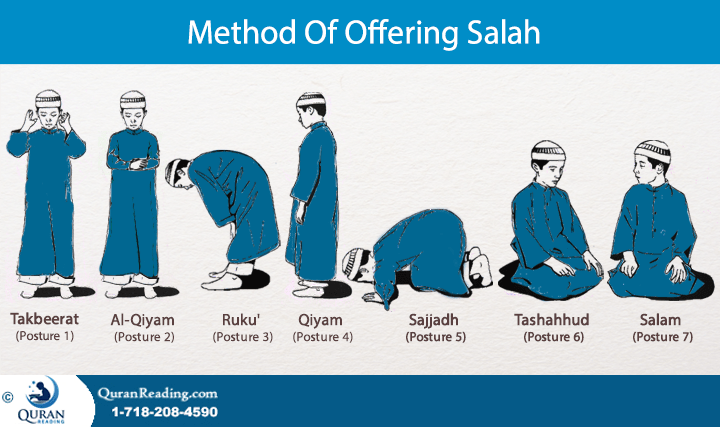
Step-by-Step Guide to Performing Solat
1. Stand Facing the Qibla
Start by positioning yourself to face the Qibla, the direction of the Kaaba in Mecca.
2. Begin the Prayer with Takbir al-Ihram
Raise your hands to your ears (or shoulders) and say the takbeer, this marks the start of your prayer.
اللهُ أَكْبَرُ
Allahu Akbar
Allah is the Greatest
3. Recite Surah Al-Fatiha
In a standing position, recite Surah Al-Fatiha, the opening chapter of the Quran.
4. Recite Another Surah or Verses from the Quran
After Al-Fatiha, you can recite another Surah or a few verses from the Quran.
5. Perform the Ruku (Bowing)
Bend at the waist with your hands on your knees, keeping your back straight. While in this position, say this 3 times
سُبْحَانَ رَبِّيَ الْعَظِيمِ وَبِحَمْدِهِ
Subhana Rabbiyal Adheemi Wa Bihamdihi
“Glory is to my Lord, the Most Great”
6. Stand Up Straight Again
Return to a standing position and say
سَمِعَ اللهُ لِمَن حَمِدَهُ، رَبَّنَا لَكَ الْحَمْدُ
Sami’ Allahu liman Hamidah, Rabbana lakal hamd
Allah hears the one who praises Him; Our Lord, to You belongs all praise
7. Perform the Sujud (Prostration)
Go down into prostration, touching your forehead, nose, palms, knees, and toes to the floor. In this position, say this 3 times
سُبْحَانَ رَبِّي الْأَعْلَى وَبِحَمْدِهِ
Subhana Rabbiyal A’la Wa Bihamdihi
Glory is to my Lord, the Most High
8. Sit Between the Two Sujuds
Sit on your legs and say
رَبِّ اغْفِرْ لِي وَارْحَمْنِي وَاجْبُرْنِي وَارْفَعْنِي وَارْزُقْنِي وَاهْدِنِي وَعَافِنِي وَاعْفُ عَنِّي
Rabbighfir li War Hamni Wajburni War Fa’ni War Zuqni Wa Ihdini Wa ‘Aafini Wa’fu ‘Anni
O Lord, forgive me, have mercy on me, support me, elevate me, provide for me, guide me, grant me health, and pardon me
9. Perform the Second Sujud
Go back down into prostration and repeat this 3 times
سُبْحَانَ رَبِّي الْأَعْلَى وَبِحَمْدِهِ
Subhana Rabbiyal A’la Wa Bihamdihi
Glory is to my Lord, the Most High
10. Complete the Rak’ah
After the second sujud, rise again to a standing position to complete the rak’ah. If you’re praying a prayer with more than one rak’ah, repeat steps 3 to 9 for each additional rak’ah.
11. Concluding the Prayer
After finishing the required number of rak’ahs, sit for the Tashahhud (testimony) and recite:
اَلتَّحِيَّاتُ لِلَّهِ وَالصَّلَوَاتُ وَالطَّيِّبَاتُ. اَلسَّلَامُ عَلَيْكَ أَيُّهَا النَّبِيُّ، وَرَحْمَةُ اللَّهِ وَبَرَكَاتُهُ. اَلسَّلَامُ عَلَيْنَا وَعَلَى عِبَادِ اللَّهِ الصَّالِحِينَ. اَشْهَدُ أَنْ لَا إِلَٰهَ إِلَّا اللَّهُ، وَأَشْهَدُ أَنَّ مُحَمَّدًا رَسُولُ اللَّهِ
At-tahiyyatu lillahi was-salawatu wat-tayyibat. As-salamu ‘alayka ayyuhan-nabi, wa rahmatullahi wa barakatuh. As-salamu ‘alayna wa ‘ala ibadillahis-salihin. Ashhadu an la ilaha illa Allah, wa ashhadu anna Muhammadur Rasoolullah.
All greetings, prayers, and good things are for Allah. Peace be upon you, O Prophet, and the mercy of Allah and His blessings. Peace be upon us and upon the righteous servants of Allah. I bear witness that there is no deity except Allah, and I bear witness that Muhammad is the Messenger of Allah.
To conclude your prayer, turn your head to the right and then to the left, saying this in each direction
السَّلَامُ عَلَيْكُمْ وَرَحْمَةُ اللَّـهِ
As-salamu ‘alaykum wa rahmatullah
Peace and mercy of Allah be upon you
Salah Tips for Beginners
- Practice Regularly: The more you practice, the more comfortable you will become. Try to pray in congregation at a mosque to learn from others.
- Learn the Meanings: Understanding what you’re saying can deepen your connection to your prayers.
- Use Prayer Guides: Many resources, including apps and books, can provide step-by-step guidance.
- Seek Help: Don’t hesitate to ask friends or family for assistance if you’re unsure about anything.
Conclusion
Performing salah is a beautiful way to connect with Allah and an essential part of being a Muslim. If you’re a beginner, it’s perfectly normal to feel a bit lost at first, but remember that with practice and sincerity, salah will become a natural part of your daily routine. Embrace this journey with an open heart, and know that your efforts to establish this important act of worship will surely be rewarded.