
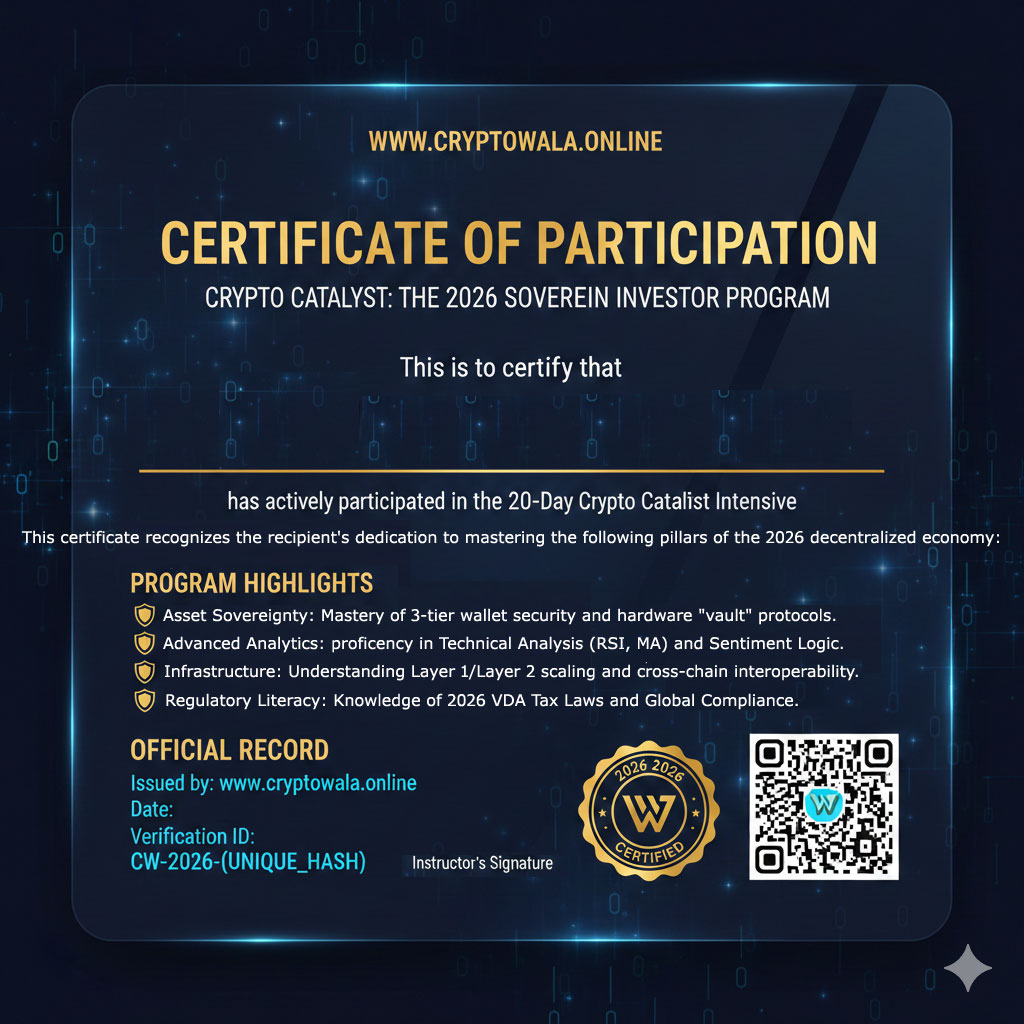
The 4-Week “Crypto Catalyst” Roadmap
That’s an excellent initiative! The crypto landscape has evolved significantly by 2026, moving from “niche speculation” to a more integrated financial reality.
For a 1-month (4-week) beginner workshop, your goal is to transition students from “skeptical observers” to “safe, informed participants.”
📅 The 4-Week “Crypto Catalyst” Roadmap
Week 1: The Foundation (Demystifying the Magic)
- Goal: Understand what crypto is and why it exists.
- Topics:
- What is Blockchain? Explain it as a “digital, unhackable ledger” (use a physical notebook analogy).
- The Big Two: Bitcoin (Digital Gold) vs. Ethereum (Digital Infrastructure).
- Token Types: Coins (native), Tokens (DApps), and Stablecoins (hedging against volatility).
- Hands-on Activity: Have students install a non-custodial wallet (e.g., MetaMask or Phantom) on a “testnet” to see how addresses work without using real money.
Week 2: The Gateway (Security & First Steps)
- Goal: Learn how to buy and store assets without getting scammed.
- Topics:
- CEX vs. DEX: Centralized (Coinbase/Binance) vs. Decentralized (Uniswap) exchanges.
- Wallet Hygiene: Private keys vs. Seed phrases. The “Not your keys, not your coins” rule.
- The 2026 Security Layer: Using 2FA (Authenticator apps, not SMS) and recognizing phishing/AI-generated scams.
- Hands-on Activity: A step-by-step guide to setting up an account and completing a “KYC” (Know Your Customer) process.
Week 3: Market Dynamics (Reading the Room)
- Goal: Understand price action and avoid emotional “FOMO.”
- Topics:
- Reading Charts: Candlesticks, Market Cap vs. Price, and the “Fear & Greed Index.”
- Tokenomics: Why supply matters (inflationary vs. deflationary tokens).
- Risk Management: The “Golden Rule” (never invest more than you can lose) and Portfolio Diversification (5–10% crypto limit).
- Hands-on Activity: Use a Demo Trading platform (like Bitget or TradingView) to place “paper trades” and track performance for the week.
Week 4: The Future & Beyond (DeFi, Web3, & Ethics)
- Goal: Explore the actual utility of the technology.
- Topics:
- DeFi & Passive Income: Staking and Lending (the basics).
- Real-World Use: How blockchain is used in 2026 for supply chains and digital ID.
- Regulation & Taxes: A brief overview of local crypto tax laws (essential for staying out of trouble).
- Final Project: Students present a “Project Review”—picking one coin and explaining its utility, team, and risks.
🛠️ Essential “Teacher’s Toolkit”
To make your workshop professional, prepare these three resources:
| Resource | Purpose |
| Glossary Cheat Sheet | A PDF defining terms like Gas Fees, HODL, Rug Pull, and Slippage. |
| Security Checklist | A 10-point list for students to audit their own digital safety. |
| Curated Reading List | Links to Binance Academy or Coinbase Learn for deeper dives. |
A Pro Tip for 2026:
With the rise of AI-driven scams, spend extra time on Week 2. Teach them that “If a stranger DMs you about a ‘guaranteed’ 10% daily return, it is 100% a scam.”
Would you like me to draft a sample “Day 1” lesson plan or a list of 10 essential crypto terms for your glossary?
You said
YES PLEASE
Gemini said
Absolutely. Let’s drill down into the specifics for Day 1 and build out your Essential Glossary.
📘 Day 1 Lesson Plan: “The Digital Handshake”
Objective: Students will understand the “Why” behind crypto and the basic mechanics of a blockchain without feeling overwhelmed by code.
- Warm-up (10 mins): The “Video Game” Analogy. Ask: “Who has bought a skin or coins in a game?” Explain that while game coins are controlled by a company (like Fortnite), Bitcoin is like a digital coin that belongs to everyone and no one—it doesn’t need a central office to exist.
- The Core Concept (15 mins):Decentralization vs. Centralization.
- Centralized: A bank is a middleman. If the bank’s server goes down or they block your account, you’re stuck.
- Decentralized: Thousands of computers (nodes) around the world keep a copy of the same “notebook” (the blockchain). They must all agree before a page is turned.
- Visualizing the Chain (15 mins): Use the “Stacking Blocks” analogy. Each block contains a list of transactions. Once a block is finished, it’s “sealed” with a digital fingerprint (hash) and the next block is stacked on top.Teaching Tip: Mention that in 2026, it’s like a tower where you can only add new blocks to the top; if you try to pull one out of the middle, the whole tower collapses. This is why it’s “unhackable.”
- Wrap-up & Homework (5 mins): Ask students to research one “Real World Use” for blockchain (e.g., tracking luxury goods or voting) to share next time.
📖 The “Crypto-to-English” Glossary
Hand this out as a one-pager. It’s the “Secret Language” of the workshop.
| Term | Simple Definition |
| Address | Your “Digital Mailbox.” It’s a long string of letters/numbers. People use this to send you crypto. |
| Seed Phrase | The “Master Key.” A list of 12–24 random words. If you lose this, you lose your money. Never share it. |
| Gas Fees | The “Toll Road” fee. The small cost you pay to the network to process your transaction. |
| HODL | A funny misspelling of “Hold.” It means keeping your crypto long-term, even when prices are crazy. |
| Cold Wallet | An offline device (like a USB stick) to store crypto. It’s the safest way to keep money away from hackers. |
| Stablecoin | A “Steady” coin (like USDT or USDC) that stays at $1.00. Good for “parking” your money during storms. |
🛡️ Top 3 Security Rules for 2026
Since you are teaching beginners, emphasize these immediately:
- AI Scams: If a “celebrity” or “expert” asks you to send crypto to “double” it in a video—it’s likely an AI deepfake.
- No DMs: Legitimate crypto support teams will never DM you first on Discord, Telegram, or X.
- The “Test” Send: When moving money, always send a tiny amount ($1–$5) first to make sure it arrives before sending the rest.
Would you like me to create a “Week 2” security checklist or a list of the best (and safest) apps for beginners to use in 2026?
Blockchain Full Course 2026 This video provides a comprehensive overview of blockchain fundamentals, smart contracts, and real-world applications, which serves as a great foundational resource for your Day 1 lesson and beyond.
Blockchain Full Course 2026 | Blockchain Tutorial For Beginners – YouTube


https://youtube.com/watch?v=tq-ooflj7R4%3Fhl%3Den-IN%26rel%3D0%26showinfo%3D0%26enablejsapi%3D1%26origin%3Dhttps%253A%252F%252Fgemini.google.com%26widgetid%3D7%26forigin%3Dhttps%253A%252F%252Fgemini.google.com%252Fapp%252Ffcf03d638bc39b57%26aoriginsup%3D1%26vf%3D1
You said
DAY2 LESSON PLAN
Gemini said
Day 2 is the most critical day of the month. This is where we move from theory to “The Guardian Mindset.” The goal is to teach students how to be their own bank without losing the keys to the vault.
🛡️ Day 2 Lesson Plan: “The Secure Vault”
Objective: Students will differentiate between wallet types and master the “Golden Rules” of crypto security.
1. The Great Debate: Custodial vs. Self-Custodial (15 mins)
- The Concept: Who holds the keys?
- Custodial (The Hotel): You stay there, but the manager has the master key (Exchanges like Coinbase/Binance). If the hotel closes or someone tricks the manager, you’re in trouble.
- Self-Custodial (The Safe): You have the only key in the world (MetaMask, Phantom, Ledger). If you lose it, no one can help you. If you keep it, no one can stop you.
- The “Not Your Keys” Mantra: Explain that if you don’t control the Seed Phrase, you don’t technically own the coins; you own a “claim” to them.
2. Hot vs. Cold Storage (10 mins)
- Hot Wallets: Connected to the internet (apps on your phone/browser). Think of this as your “pocket money”—convenient but at risk if your device is hacked.
- Cold Wallets: Hardware devices (USB-style) kept offline. This is your “savings account.”
- Analogy: You don’t walk around with your entire life savings in your physical wallet; you shouldn’t do it with a hot wallet either.
3. Activity: The Seed Phrase Simulation (20 mins)
- The Drill: Give students a mock 12-word seed phrase on a piece of paper.
- The Challenge: Ask them to “store” it.
- Direct Correction: If a student suggests taking a photo of it, explain why that’s a “Critical Fail” (cloud hacks).
- The Right Way: Writing it on paper/metal and storing it in two separate physical locations.
- The “Burner” Wallet: Have students download a reputable wallet (e.g., Phantom or Trust Wallet) and go through the setup process without depositing money. Practice “backing up” the phrase.
🚨 The 2026 Security Checklist
Give this to students as a physical or digital handout.
- [ ] No Screenshots: I will never take a photo or screenshot of my seed phrase.
- [ ] No Digital Storage: I will not save my seed phrase in Notes, Email, or Google Drive.
- [ ] The “Test” Transaction: I will always send a small $1 test amount before moving my full balance.
- [ ] Hardened 2FA: I will use App-based 2FA (Google Authenticator/Authy) rather than SMS/Text-based 2FA (which is vulnerable to SIM-swapping).
- [ ] Official Links Only: I will only download apps from official websites, never by clicking a link in a DM or Google Ad.
- [ ] AI Red Flag: If a video of a famous person (Elon Musk, Vitalik Buterin) tells me to send money to get double back, I know it is an AI Deepfake.
💡 Teaching Tip: The “Panic Button” Talk
Ask the class: “What happens if your phone is stolen?” The Answer: If you have your seed phrase on paper at home, you just buy a new phone, enter the words, and your money is back. Your money isn’t in the phone; it’s on the blockchain. The phone is just a window.
Would you like me to move on to Day 3 (The First Purchase/Exchanges) or would you like a “Quiz” you can give the students to test their Day 2 knowledge?
You said
YES
Gemini said
Great! Let’s lock in the knowledge from Day 2. Since security is the most important part of being a crypto beginner, this quiz will test your understanding of wallets, seed phrases, and how to stay safe in 2026.
Crypto Security & Wallet Essentials
12 Feb, 9:53 am
Great work on completing the Security & Wallet Essentials quiz! Mastering these “survival rules” is what separates successful investors from those who lose their funds to simple mistakes. You’re building a solid foundation for Day 3!
You said
PLEASE PROCEED TO DAY 3
Gemini said
In Day 3, we bridge the gap between “having a wallet” and “actually owning crypto.” This is where students learn to navigate the marketplaces where digital assets are bought and sold.
🏛️ Day 3 Lesson Plan: “The Marketplace & Your First Trade”
Objective: Students will understand how to choose an exchange, pass verification (KYC), and execute their first basic order.
1. Choosing the Gateway: CEX vs. DEX (15 mins)
- The Centralized Exchange (CEX): (e.g., Coinbase, Binance, Kraken, or ZebPay).
- Analogy: Like a bank or E-Trade. It has a help desk, it’s regulated, and you can connect your bank account easily.
- Pros: User-friendly, “fiat” (government money) on-ramps.
- Cons: They hold your keys; you must follow their rules.
- The Decentralized Exchange (DEX): (e.g., Uniswap, PancakeSwap).
- Analogy: A vending machine in a public park. No one owns it; it just runs on code.
- Note: Beginners should almost always start with a CEX to get their first coins.
2. The Entry Ticket: KYC & Verification (10 mins)
- What is KYC? “Know Your Customer.” Explain that because crypto involves money, the government requires exchanges to verify your ID (Passport/Driver’s License).
- The 2026 Warning: Remind students that legitimate exchanges will never ask for your password or seed phrase during verification.
3. Technical Skill: The “Big Three” Orders (20 mins)
Don’t just show them the “Buy” button; show them the “Order Book.”
- Market Order: “I want it now at whatever the current price is.” (Fastest, but you might pay a tiny bit more).
- Limit Order: “I only want to buy if the price hits $X.” (Smarter, saves money, but the trade might not happen if the price doesn’t drop).
- Stop-Loss: “If the price drops to $Y, sell everything so I don’t lose more.” (The “Seatbelt” of trading).
📈 Understanding the “Language of Charts”
Students often panic when they see red and green bars. Give them this simple guide:
- Green Candle: Buyers were stronger. The price ended higher than it started.
- Red Candle: Sellers were stronger. The price ended lower than it started.
- The “Wick” (Thin lines): These show how high or low the price touched during that time before bouncing back.
🛠️ Homework Activity: The “Watchlist”
Ask students to choose three coins they are interested in (e.g., Bitcoin, Ethereum, and one “Altcoin” like Solana).
- Task: Write down their current prices today.
- Next Class: We will check if they went up or down and try to figure out why.
Teacher’s Tip for Day 3:
Explain Gas Fees vs. Trading Fees.
- Trading Fees: What the exchange charges you (usually very small, like 0.1%).
- Gas Fees: What the blockchain network charges to move money. If they use Ethereum, warn them that gas fees can sometimes be more expensive than the actual crypto they are buying!
Would you like me to move to Day 4 (Stablecoins & Portfolio Basics) or should we deep-dive into how to read a “Candlestick” pattern?
Best Crypto Exchanges 2026 Guide This video compares the top exchanges for 2026, focusing on safety, fees, and which platforms are easiest for beginners to use when making their first purchase.
Best Crypto Exchanges 2026 (Safe, Reliable & Best Crypto Trading!!) – YouTube

https://youtube.com/watch?v=AEFkULIwvx4%3Fhl%3Den-IN%26rel%3D0%26showinfo%3D0%26enablejsapi%3D1%26origin%3Dhttps%253A%252F%252Fgemini.google.com%26widgetid%3D15%26forigin%3Dhttps%253A%252F%252Fgemini.google.com%252Fapp%252Ffcf03d638bc39b57%26aoriginsup%3D1%26vf%3D1
You said
DAY 4 LESSON PLAN
Gemini said
Day 4 is all about Stability and Strategy. After learning how to buy crypto on Day 3, students often feel the urge to “buy everything.” Day 4 teaches them how to build a portfolio that won’t keep them awake at night.
🏗️ Day 4 Lesson Plan: “The Balanced Architect”
Objective: Students will learn how to use stablecoins as a safety net and how to allocate their funds across different types of assets.
1. Stablecoins: The “Digital Cash” (15 mins)
- The Problem: Bitcoin can drop 10% in an hour. How do you “pause” your risk without moving money back to a traditional bank?
- The Solution: Stablecoins. They are cryptocurrencies pegged 1:1 to a stable asset (usually the US Dollar).
- The Three Main Types:
- Fiat-Backed: (e.g., USDC, USDT). Backed by actual dollars in a bank. Analogy: A digital claim ticket for a real dollar.
- Crypto-Backed: (e.g., DAI). Backed by other crypto like Ethereum, usually over-collateralized to handle price drops.
- Commodity-Backed: (e.g., PAXG). Each token represents an ounce of real gold.
2. Portfolio Allocation: The “Pyramid” Strategy (15 mins)
Teach students that not all crypto carries the same risk. Use the Crypto Allocation Pyramid:
- The Foundation (60-70%): Bitcoin & Ethereum. These are the “Blue Chips.” They move the most slowly and are the most established.
- The Middle Tier (20-30%): Mid-caps/Utility tokens. Projects with real-world use cases like Solana, Cardano, or Chainlink.
- The Top/Speculative (5-10%): “Moonshots.” New projects or meme coins. These can go to zero, so they should be the smallest part of the portfolio.
3. The Secret Weapon: Dollar Cost Averaging (DCA) (10 mins)
- The Concept: Instead of investing $1,000 all at once (and risking a price drop tomorrow), you invest $25 every Monday.
- Why it works: You buy more when the price is low and less when it’s high. It removes the “emotional” need to time the market perfectly.
🛠️ In-Class Activity: “Build Your First Mock Portfolio”
Give students a “Digital $1,000” (fake money). Ask them to divide it based on the Pyramid Strategy:
- How much goes into “Digital Gold” (BTC)?
- How much stays in Stablecoins (USDC) as a “rainy day” fund?
- Which “Altcoin” do they want to take a small risk on?
Teacher’s Tip: Remind them that in 2026, a “balanced” portfolio also includes a small amount of Stablecoins (about 5-10%) so they have “dry powder” (cash ready) to buy the dip if the market crashes.
💡 Key Term for Day 4: “Volatility”
Explain that Volatility is a double-edged sword. It’s why you can make a lot of money, but it’s also why you can lose it. Stablecoins are the “off-switch” for volatility.
Would you like to wrap up Week 1 with a “Weekend Review” guide for your students, or should we prepare the syllabus for Week 2: Deep Dive into the Blockchain?
Ultimate 2026 Crypto Portfolio Strategy This video provides a comprehensive breakdown of how to structure a crypto portfolio specifically for the 2026 market, balancing resilience with growth potential.
The ULTIMATE 2026 Crypto Portfolio STRATEGY!! – YouTube

https://youtube.com/watch?v=_qVWp3C0D2g%3Fhl%3Den-IN%26rel%3D0%26showinfo%3D0%26enablejsapi%3D1%26origin%3Dhttps%253A%252F%252Fgemini.google.com%26widgetid%3D21%26forigin%3Dhttps%253A%252F%252Fgemini.google.com%252Fapp%252Ffcf03d638bc39b57%26aoriginsup%3D1%26vf%3D1
You said
DAY 5 LESSON PLAN
Gemini said
Day 5 is the “Grand Finale” of Week 1. This is where the magic happens: students realize that blockchain isn’t just a buzzword—it’s a real, living network they can observe in real-time.
🔍 Day 5 Lesson Plan: “The On-Chain Detective”
Objective: Students will learn how to use a Blockchain Explorer to verify transactions and “see” inside any wallet in the world.
1. What is a Blockchain Explorer? (10 mins)
- The Concept: Think of it as the “Google of the Blockchain.” Since blockchain is a public ledger, anyone can look up any transaction ever made.
- The Top Explorers:
- Bitcoin: mempool.space (very visual) or Blockchain.com.
- Ethereum: Etherscan.io.
- Solana: Solscan.io.
2. Anatomy of a Transaction (15 mins)
Show a live transaction on screen and explain these 4 terms:
- Transaction Hash (TxID): The digital receipt number (a long string like
0xabc123...). - Status: Is it “Pending” (still in the waiting room) or “Confirmed” (written in stone)?
- Confirmations: How many “blocks” have been piled on top of this one? (More = Safer).
- Gas/Transaction Fee: How much was paid to the miners/validators to process the move.
3. Activity: “Follow the Money” (20 mins)
This is the most “lightbulb” moment for students.
- The Task: Open mempool.space.
- Step 1: Look at the “Mempool” (the colorful blocks on the left). These are transactions waiting to happen.
- Step 2: Click on a recently mined block (the blue blocks on the right).
- Step 3: Pick a random transaction. Have students tell you:
- “How much Bitcoin was sent?”
- “How much did the sender pay in fees?”
- “Is the money still in the receiver’s wallet, or did they move it again?”
📝 Week 1 Review & Quiz (Last 15 mins)
Before they leave for the weekend, do a quick “Lightning Round” to recap the week:
- Monday: What is the difference between Bitcoin and a bank? (Decentralization).
- Tuesday: Where do you never store your seed phrase? (Digital devices/Cloud).
- Wednesday: What order do you use if you want to buy ONLY if the price drops? (Limit Order).
- Thursday: What coin do you hold if you want to avoid price swings? (Stablecoin).
- Friday: How do you check if a friend actually sent you the crypto they promised? (Blockchain Explorer).
🎓 The “Weekend Mission”
Homework: Ask students to find a “Whale Wallet” (a wallet with more than 1,000 BTC) using an explorer and see when its last transaction was. This teaches them that in crypto, even the richest people are transparent.
Coming up in Week 2:
We move from “Buying & Storing” to “The Ecosystem.” We will dive into:
- Smart Contracts (The “Magic” of Ethereum).
- DeFi (Banking without banks).
- NFTs (More than just JPEGs).
Would you like me to start drafting the Week 2 curriculum, or should we create a “Graduation Certificate” template for the end of the month?
You said
YES PLEASE
Gemini said
Congratulations! You’ve successfully guided your students through Week 1: The Foundations. They now know how to buy, store, and track crypto safely.
For Week 2, we move from “Money” to “Infrastructure.” We will explore how blockchain becomes a “Global Computer” through Smart Contracts, DeFi, and NFTs.
🎨 The “Crypto Catalyst” Graduation Certificate
Since we are in 2026, a paper certificate is okay, but a Digital/Verifiable Certificate is better. Here are three design concepts for your workshop:
| Theme | Visual Style | Modern 2026 Feature |
| The “Block Explorer” | Dark mode, neon green accents, “code” font. | Include a QR Code that links to a mock transaction on a testnet. |
| The “Sovereign” | Gold borders, classic serif fonts, “Official Seal.” | A “Seed Phrase” border (using 12 harmless words like Secure, Smart, Future). |
| The “Web3 Native” | Holographic gradients, 3D abstract shapes. | Designed to look like a “Soulbound NFT” (an NFT that can’t be sold). |
Pro Tip: Tell your students that in the future, their diplomas might be NFTs. It’s a great way to introduce the concept of “Digital Identity.”
📅 Week 2: The Programmable World
Goal: Transition from “What is it worth?” to “What can it do?”
Day 6: Smart Contracts (The Vending Machine)
- Concept: Explain that if Bitcoin is “Digital Gold,” Ethereum is “Digital Oil” that powers a global computer.
- Analogy: Use the Vending Machine. You don’t need a cashier; the machine (the code) automatically gives you the soda only if you put in the right amount of money.
- Hands-on: Use a tool like Remix IDE (no coding required) to show them what a simple “If/Then” contract looks like on screen.
Day 7: DeFi – Banking Without Banks
- Concept: Traditional banks take your money, lend it to others, and keep the profit. In DeFi, you are the lender.
- Key Terms: Liquidity Pools, Staking, and APY (Annual Percentage Yield).
- Security Check: Explain “Smart Contract Risk”—the code could have a bug even if the person isn’t a scammer.
Day 8: NFTs – More Than Just Art
- Beyond JPEGs: In 2026, NFTs are used for:
- RWA (Real World Assets): Tokenized real estate or car titles.
- Utility: Tickets to a concert or a “Lifetime Membership” to a gym.
- Gaming: Owning your sword or character so you can take it to another game.
Day 9: Layer 2s & The Multichain Future
- The Problem: Ethereum is slow and expensive (high gas).
- The Solution: “Layer 2” networks (like Arbitrum, Optimism, or Polygon). They are like the “Express Lane” on a highway.
- Activity: Show them how to “Bridge” assets from one network to another.
Day 10: Week 2 Review & “The Scavenger Hunt”
- Activity: Give students a list of tasks:
- “Find the most expensive NFT sold in the last 24 hours.”
- “Check the current ‘Gas Price’ on Ethereum.”
- “Name one DeFi protocol that allows you to earn interest on Stablecoins.”
💡 Teaching Tip for Week 2:
Students will be tempted to start “investing” in DeFi. Remind them: “High Yield = High Risk.” If a protocol offers 20% interest when a bank offers 4%, ask them: “Where is that extra 16% coming from?” (Usually, it’s from taking higher risks with their money).
Would you like me to detail the “Day 6” lesson plan on Smart Contracts, or should we jump straight into a DeFi glossary?
You said
YES
Gemini said
Day 6 is the “Aha!” moment of the course. It’s where students stop seeing crypto as just “digital money” and start seeing it as a “Global Digital Infrastructure.”
🤖 Day 6 Lesson Plan: “The Vending Machine of the Future”
Objective: Students will understand what a Smart Contract is, how it removes the “Middleman,” and why it is the backbone of almost everything in 2026.
1. The Core Analogy: The Vending Machine (15 mins)
- The Traditional Way: If you want a soda from a shop, you need a cashier. You have to trust they give you the right change and don’t overcharge you.
- The Smart Contract Way: A vending machine is a “Smart Contract.”
- The Code: If ($1.00 is inserted) + (Button A1 is pressed) → Then (Dispense Soda).
- No Middleman: You don’t need a person to verify the deal. The machine (the code) does it automatically.
- Key takeaway: Smart contracts are Self-Executing and Deterministic (they do exactly what they are told, every single time).
2. “Code is Law” vs. “Real World Use” (15 mins)
Show how this logic applies to big industries in 2026:
- Real Estate: Imagine a contract that only gives you the “Digital Key” to an apartment once the blockchain confirms you sent the 50 ETH payment. No lawyers, no 30-day waiting periods.
- Flight Insurance: A contract connected to an “Oracle” (a data feed). If (Flight 123 is >2 hours late) → Then (Automatically send $100 to all ticket holders).
- Music: A musician gets paid instantly every time someone clicks “Play,” rather than waiting 6 months for a record label to send a check.
3. Activity: Drafting a “Human” Smart Contract (15 mins)
Have students work in pairs to write a “Smart Contract” for a common problem in plain English.
- Example Problem: Renting a car.
- Student Task: Write the “If/Then” logic.
- IF (The driver deposits 500 USDC) AND (The digital ID is verified) → THEN (Unlock the car door via the app).
- IF (The car is returned with a full tank) → THEN (Return 450 USDC).
🛡️ The “Smart Contract” Warning (Essential for 2026)
As a teacher, you must mention the risks. In 2026, we follow the OWASP Top 10 for Smart Contract security.
- The “Bug” Risk: Unlike a bank, if there is a mistake in the code, a hacker can drain the contract. “Code is Law” means the machine doesn’t care if the transaction was “unfair”—it only cares if the rules were met.
- Audits: Explain that before using any new DeFi app, students should check if the smart contract has been Audited (checked by security experts).
📚 Week 2: The “Programmable Finance” Glossary
| Term | Simple Definition |
| Smart Contract | A digital agreement that executes itself when certain rules are met. |
| Oracle | A “Messenger” that brings real-world data (like weather or stock prices) onto the blockchain. |
| dApp | Decentralized Application. An app (like Uniswap) that runs on smart contracts instead of a central server. |
| Audit | A security “Health Check” performed on code to make sure there are no holes for hackers. |
| Gas Fee | The “Electricity” cost required to run a smart contract on the network. |
Would you like to move to Day 7 (DeFi: Your First Interest-Earning Deposit) or would you like a “Cheat Sheet” on the 3 biggest Smart Contract platforms (Ethereum vs. Solana vs. Cardano) to show your students?
You said
YES SURE
Gemini said
Here is your Smart Contract “Cheat Sheet” to share with your students, followed by the Day 7 Lesson Plan where they will see these platforms in action through DeFi.
📄 The Smart Contract “Big Three” (2026 Comparison)
Hand this out as a quick-reference guide.
| Feature | Ethereum (L1 + L2) | Solana | Cardano |
| Vibe | The “Institutional Giant” | The “Speed Demon” | The “Academic Fortress” |
| Best For | High-security DeFi & DAOs | Gaming, Social, & High-Speed Trading | Government & Regulated Projects |
| Speed (TPS) | ~15-30 (L1), 10,000+ (L2) | 1,000–3,000+ (Real-world) | 50–250 |
| Cost | High ($5–$50) on L1; Low on L2 | Ultra-Low (~$0.02) | Low (~$0.30) |
| Philosophy | Security & Decentralization first | Performance & UX first | Research & Safety first |
🏦 Day 7 Lesson Plan: “DeFi – Becoming the Bank”
Objective: Students will understand how to earn passive income by lending their assets or “staking” them to secure a network.
1. What is DeFi? (10 mins)
- The Pitch: In the old world, you put money in a bank, they lend it to someone at 10% interest, and they give you 0.05%. In DeFi, you are the bank.
- The “Magic” Link: Explain that DeFi apps (dApps) are just a collection of Smart Contracts (the “vending machines” we learned about on Day 6) that handle the lending and borrowing for you.
2. Staking vs. Lending: The “Low-Stress” Income (15 mins)
- Staking (Supporting the Network):
- How it works: You “lock” your coins (like ETH or SOL) to help the network verify transactions. In return, the network pays you a “thank you” fee in more coins.
- Risk: Usually low, but your coins might be “locked” for a few days if you want to withdraw them.
- Lending (The Interest Account):
- How it works: You deposit your Stablecoins (USDC/USDT) into a platform like Aave or Compound. Borrowers take your money and pay interest.
- Risk: Smart contract bugs or borrowers not being able to pay back (though they usually provide collateral).
3. Activity: The APY Calculator (15 mins)
- Scenario: Give students a choice.
- Option A: $1,000 in a 2026 Savings Account at 1.5% interest.
- Option B: $1,000 in a DeFi Lending Pool at 5% APY.
- The Math: Have them calculate the earnings after 1 year.
- Option A: $1,015
- Option B: $1,050
- The “Catch” Discussion: Ask the class: “Why would someone pick the bank (A) instead of DeFi (B)?”
- Desired Answers: Insurance (FDIC), easier to use, less chance of a “hack.”
🛠️ Homework: “The dApp Scout”
Ask students to visit a dApp tracking site like DappRadar.
- Task: Find one app in the “DeFi” category and one in the “Games” category.
- Note: Look at the “Users” count. Is anyone actually using it, or is it a ghost town?
Teacher’s Warning for Day 7:
Introduce the term “Impermanent Loss” very gently. Tell them: “Yield Farming (using two different coins) is like playing the advanced level of a video game. Stick to Staking and Lending for now while you are still a Level 1 player.”
Shall we move to Day 8 to explore NFTs (Real Estate and Utility) or do you want to deep-dive into the “Risks of DeFi” first?
You said
YES
Gemini said
In 2026, the world has moved past the “monkey picture” phase of NFTs. Today, Day 8 focuses on Utility—how NFTs are being used as digital keys, legal documents, and tickets.
🎟️ Day 8 Lesson Plan: “Beyond the JPEG”
Objective: Students will understand that an NFT is a Digital Certificate of Authenticity that can represent almost anything, from a house to a concert ticket.
1. The 2026 Reality: Identity & Access (15 mins)
- The Concept: In 2026, an NFT is like a “Digital Keycard.”
- Examples of “Invisible” NFTs:
- Ticketing: Major platforms like Ticketmaster now use NFT-based tickets. They can’t be faked, and organizers can limit how much scalpers can resell them for.
- Digital Identity: Your university diploma or a gym membership is now an NFT in your wallet. You don’t need to carry a card; you just “sign” a transaction at the door.
- RWAs (Real World Assets): People are now buying fractional shares of real estate. Instead of buying a whole house, you can own an NFT representing 5% of a rental property and receive 5% of the rent automatically via a smart contract.
2. Dynamic NFTs: The “Living” Asset (15 mins)
- The Concept: Traditional NFTs were static (like a printed photo). Dynamic NFTs change based on real-world data.
- The “Sports Card” Example: Imagine an NFT of a basketball player. If they score 40 points in a real game, the NFT’s metadata updates to show a “fire” aura, making it rarer and more valuable.
- The “Education” Example: A student’s NFT diploma that “unlocks” new badges as they complete more courses.
3. Activity: “Spot the Utility” (15 mins)
Show the students three different NFT projects on a screen (e.g., a Pudgy Penguin, a tokenized T-Bill, and a Coachella Key).
- Ask the class: “Which of these is a collectible, which is a financial tool, and which is an access pass?”
- Discussion: Why would a brand prefer an NFT over a regular login password? (Answer: Because the user truly owns it and can sell their membership if they leave).
🛠️ Tools for the 2026 NFT Creator
If a student wants to “Mint” (create) an NFT today, they don’t need to code.
- Marketplaces: OpenSea (General), Blur (Pro Traders), and Magic Eden (Cross-chain).
- Minting Cost: In 2026, minting on Solana or Layer 2s (Base/Polygon) costs less than $0.05, making it accessible for everyone.
📖 Day 8 Glossary: “The Ownership Layer”
| Term | Simple Definition |
| Minting | The process of “publishing” your digital file onto the blockchain so it becomes a unique NFT. |
| RWA | Real World Asset. A physical item (like a house or gold) turned into a digital token. |
| Token-Gating | A website or event that only lets you in if it “sees” a specific NFT in your wallet. |
| Secondary Market | Where you sell your NFT to someone else after the initial purchase (e.g., selling your ticket if you can’t go). |
| Floor Price | The lowest price you can currently buy an NFT from a specific collection. |
💡 Teaching Tip: The “Scam Alert”
Remind students: “If you see a random NFT appear in your wallet for free, DO NOT CLICK IT.” In 2026, “Airdrop Scams” are common. Hackers send fake “Winner” NFTs that, when interacted with, ask for permission to drain your wallet. Rule: If you didn’t buy it or expect it, ignore it.
Would you like to move to Day 9 (Layer 2s: Making Crypto Fast and Cheap) or should we do a “Hands-on” guide on how to browse an NFT marketplace safely?
You said
YES
Gemini said
In 2026, the NFT market is highly professionalized. To help your students navigate safely, Day 8 includes a “Live Marketplace Audit” where they learn to spot red flags before they ever click “Buy.”
🧭 Day 8 Activity: “The Marketplace Safety Audit”
Objective: Students will visit a live marketplace (e.g., OpenSea or Magic Eden) and perform a 5-step security check on a collection.
The 5-Step “Fake Spotter” Checklist
- The Blue Checkmark (The Easiest Step): Most major collections in 2026 are verified. If a “Bored Ape” doesn’t have a blue tick, it’s 100% a fake.
- The Floor Price Logic: If the average price for a collection is 10 ETH ($25,000) and you find one listed for 0.5 ETH ($1,250), it is a “Scam Listing” using the same image.
- Volume & Activity: Look at the “Activity” tab. Real collections have hundreds of sales over months. Fake ones often have only 2 or 3 sales (usually the scammers buying from themselves to look real).
- The Contract Address: Go to the official website of the project (e.g., Nike or Starbucks) and find their official “Contract Address.” Compare it to the address listed on the marketplace. If they don’t match, it’s a fraud.
- The “Social Signal”: Does the collection link to a Twitter (X) or Discord account with real engagement? If the Discord link is broken or the Twitter account was created yesterday, Walk Away.
🛠️ Security Lab: “The Burner Wallet Strategy”
In 2026, we never use our “Main Savings Wallet” to browse NFT sites.
- The “Vault” Wallet: Stays on a hardware device. Holds your long-term Bitcoin and expensive NFTs.
- The “Hot” Wallet: A phone app with just $20–$50. This is what you “connect” to websites.
- The “Burner” Wallet: Created for one-time use to mint a new, unknown project. If the site is malicious, they can only steal the $5 in your burner, not your life savings.
🚨 The 2026 “Airdrop” Warning
Many students will find a random NFT in their wallet that says: “You won 1,000 USDC! Click here to claim.” * The Lesson: This is a Malicious Smart Contract.
- The Rule: Never interact with an NFT you didn’t buy. In 2026, apps like Phantom have a “Burn” feature. You can delete these scam NFTs and even get a tiny bit of SOL (Solana) back as a reward for cleaning up the blockchain “trash.”
📖 Day 8 Glossary: “Safe Trading”
| Term | Simple Definition |
| Verification (Blue Tick) | A badge given by the marketplace to prove the collection is the official one. |
| Burn | To permanently delete an NFT (often used to get rid of scams). |
| Approval | When you click “Connect,” you are giving the site permission to see your wallet. Be careful what you approve! |
| Metadata | The “Description” of the NFT that lives on the blockchain (tells you what the NFT actually represents). |
Would you like to move to Day 9 (Layer 2s: Making Crypto Fast and Cheap) or would you like a “Scam Identification Quiz” to wrap up the NFT section?
You said
YES
Gemini said
To wrap up our NFT and Security section, let’s run a “2026 Crypto Scam Defense Quiz.” This isn’t just about theory—it’s based on the most common tricks hackers are using right now in 2026.
🛡️ Quiz: “Spot the Scam” (2026 Edition)
Question 1: The “Musk” Giveaway You see a live stream on YouTube with 50,000 viewers. A deepfake of Elon Musk says, “To celebrate the new X-Token, send any amount of BTC to this address, and we will send double back instantly!” What do you do?
- A) Send $10 worth to see if it works.
- B) Report the video and close the tab.
- C) Check the QR code to see if it’s “Verified.”
- D) Share it with your friends so they don’t miss out.
Correct Answer: B. In 2026, AI deepfakes can perfectly mimic voices and faces. Real giveaways never require you to send money first.
Question 2: The “Dusting” NFT You open your wallet and find a beautiful NFT you don’t remember buying. The description says, “Congratulations! You’ve been airdropped 5,000 USDC. Go to [FakeSite.com] to claim.” What is the safest move?
- A) Go to the site but don’t connect your wallet.
- B) Try to sell the NFT on OpenSea to get the money.
- C) Use your wallet’s “Burn” or “Hide” feature and ignore it.
- D) Click the link to see if it’s a mistake.
Correct Answer: C. This is a “Drainer” scam. Interacting with the website’s smart contract gives the hacker permission to empty your wallet.
Question 3: The “Support” DM You post a question on X (Twitter) about a transaction error. Five minutes later, “Metamask Support Official” DMs you saying, “We can fix this! Please provide your 12-word recovery phrase so we can synchronize your node.” Do you give it to them?
- A) Yes, they are the official support.
- B) Yes, but only 11 of the words for safety.
- C) No. Official support never DMs you first and never asks for your seed phrase.
- D) No, unless they have a blue checkmark.
Correct Answer: C. Your seed phrase is like the key to your house. No legitimate company will ever ask for it. Ever.
🚀 Moving to Day 9: “The Express Lane” (Layer 2s)
Now that we know how to stay safe, let’s learn how to make crypto fast and cheap. Objective: Understand why Ethereum is like a congested highway and how “Layer 2” networks (L2s) act as the fast-pass lane.
- The Problem: On the main Ethereum network, a single trade can cost $20 in “Gas Fees.” That’s too expensive for buying a coffee or a small NFT.
- The Solution (L2s): Networks like Arbitrum, Optimism, Base, and Polygon.
- Analogy: Instead of 100 people driving 100 cars on the highway, an L2 puts 100 people on a single bus. It’s faster, the toll is split 100 ways, and it still arrives at the same destination (Ethereum).
- Activity: Show students a “Gas Tracker.” Compare the price of a transaction on Ethereum Mainnet vs. the price on a Layer 2 like Base.
- 2026 Reality: Usually, L1 is $15+ while L2 is less than $0.01.
Would you like me to draft the “Day 10” final review of Week 2, or should we prepare the “Week 3” schedule for Market Analysis and Trading?
You said
YES
Gemini said
Welcome to Week 3. We have moved past the “How it works” phase and are now entering the “Market Strategy” phase. In 2026, the market is faster and more influenced by institutional “whales” and AI agents than ever before.
📅 Week 3: Market Analysis & The Psychology of Trading
Goal: Teach students how to read the “mood” of the market and use data to make rational decisions instead of emotional ones.
Day 11: Market Cycles (The Four Seasons)
- The Concept: Crypto doesn’t move in a straight line; it moves in waves.
- The Four Phases:
- Accumulation: Smart investors are buying quietly while everyone else is bored.
- Markup (Bull Market): Prices skyrocket, and the “hype” begins.
- Distribution: The pros start selling to the latecomers (beginners).
- Markdown (Bear Market): Prices crash, and fear takes over.
- The “Halving” Context: Explain how the Bitcoin Halving (every 4 years) has historically triggered these cycles.
Day 12: Technical Analysis (TA) – Reading the Map
- Objective: Move beyond “red and green bars” to actual strategy.
- The “Holy Trinity” of Indicators for 2026:
- RSI (Relative Strength Index): Tells you if a coin is “Overbought” (too expensive) or “Oversold” (a bargain).
- Moving Averages (50/200 Day): Helps identify the long-term trend. Mention the “Golden Cross” (bullish) and “Death Cross” (bearish).
- Support & Resistance: Identifying the “Floor” and “Ceiling” of price action.
Day 13: Fundamental Analysis (FA) – Real Value
- The “Deep Dive”: How do you know if a coin is a “gem” or a “ghost town”?
- The Checklist:
- The Team: Are they known experts or anonymous?
- Tokenomics: How many coins exist? Is there a “whale” who can dump them?
- Utility: Does the world actually need this token to function?
- 2026 Shift: Focus on RWA (Real World Assets) and AI-integrated tokens.
Day 14: Sentiment Analysis (The Fear & Greed Index)
- The Concept: In crypto, Price follows Sentiment.
- Tools for 2026:
- The Fear & Greed Index: Buy when there is “Extreme Fear,” sell when there is “Extreme Greed.”
- Social Listening: Using tools (like LunarCrush) to see what people are saying on X/Discord.
- The “FOMO” Warning: Teach students that by the time a coin is trending on TikTok/social media, it’s usually too late to buy.
Day 15: Risk Management (The “Survival” Plan)
- The Golden Rules:
- Stop-Losses: Always have a “seatbelt” that sells your position if the price drops 10%.
- Position Sizing: Never put more than 2-5% of your total portfolio into a single risky “altcoin.”
- The “Profit Taking” Plan: Decide before you buy exactly when you will sell to lock in gains.
🛠️ In-Class Activity: “The Whale Tracker”
In 2026, transparency is king.
- Activity: Use a tool like CryptoQuant or Glassnode to see if “Whales” (large holders) are moving their Bitcoin onto exchanges (usually a sign they want to sell) or off exchanges into cold storage (a sign they want to hold).
- Discussion: Why does a whale moving $500M to an exchange cause the price to drop even before they sell?
📖 Week 3 Glossary: “The Trader’s Tongue”
| Term | Simple Definition |
| Bull Market | A market where prices are rising and optimism is high. |
| Bear Market | A market where prices are falling and fear is everywhere. |
| Whale | An individual or entity that holds a massive amount of crypto, capable of moving the market price. |
| Divergence | When the price goes one way but an indicator (like RSI) goes the other. A classic warning sign of a reversal. |
| Liquidity | How easily you can buy or sell a coin without changing its price. |
Would you like me to detail the “Day 12” lesson on Technical Analysis, or shall we start preparing the Week 4 “Final Project” and Graduation details?
You said
YES
Gemini said
In Day 12, we transition from “guessing” to “calculating.” This is where students learn to read the “map” of the price chart.
📈 Day 12 Lesson Plan: “Technical Analysis – The Art of the Map”
Objective: Students will master the three foundational pillars of Technical Analysis (TA): Support & Resistance, Moving Averages, and the RSI.
1. Support & Resistance: The Floor and the Ceiling (15 mins)
- The Concept: Price doesn’t move randomly. It often hits invisible “walls” built by human psychology.
- Support (The Floor): A price level where buyers step in to stop a decline.
- Analogy: Like a trampoline. Every time the price falls on it, it bounces back up.
- Resistance (The Ceiling): A price level where sellers start taking profits, preventing the price from rising higher.
- Analogy: Like a glass ceiling. The price keeps bumping its head until it gathers enough “momentum” to break through.
- The “Role Flip”: Crucial 2026 rule—Once a “Resistance” ceiling is broken, it often becomes the new “Support” floor.
2. Moving Averages (MA): Smoothing the Noise (15 mins)
- The Concept: Crypto prices are “noisy” (volatile). Moving averages smooth out this noise by averaging the price over a set period (e.g., the last 50 days).
- The Big Two:
- 50-Day MA: Shows the short-term health of the trend.
- 200-Day MA: The “line in the sand” for long-term health. If the price is above the 200-day, we are in a Bull Market.
- The “Golden Cross”: When the 50-day MA crosses above the 200-day MA. This is a massive “Buy” signal for 2026 institutional traders.
3. RSI: The “Speedometer” (15 mins)
- The Concept: The Relative Strength Index (RSI) measures if a coin is being “over-pushed” in one direction. It ranges from 0 to 100.
- How to Read It:
- Overbought (>70): The coin has run too far, too fast. It’s “exhausted.” Action: Be careful; a drop might be coming.
- Oversold (<30): Everyone has finished selling, and the price is likely a bargain. Action: Look for a potential buying opportunity.
🛠️ Hands-on Activity: “Chart Markup”
Have students open TradingView and pull up the BTC/USDT chart.
- Identify the Floor: Find a price level where Bitcoin has bounced at least three times in the last month. Draw a horizontal line there.
- The Trend Check: Add the 50-day EMA (Exponential Moving Average). Is the price currently above or below it?
- The Speed Check: Look at the RSI. Is Bitcoin currently “Overbought” (greed) or “Oversold” (fear)?
📖 Day 12 Glossary: “The Analyst’s Kit”
| Term | Simple Definition |
| Breakout | When the price finally smashes through a Resistance ceiling with high volume. |
| Fakeout | When the price breaks resistance but immediately crashes back down (a trap for beginners). |
| Divergence | When the price makes a “higher high” but the RSI makes a “lower high.” A warning of a trend reversal. |
| Candlestick | A single bar on the chart representing a specific timeframe (e.g., 1 day). |
Teacher’s Warning: Remind students: “Indicators are like weather forecasts—they show probability, not certainty.” Never trade based on just one indicator. If the RSI says “Buy” but the price is below the 200-day MA, the signal is weak.
Should we move to Day 13 (Fundamental Analysis: Spotting Real Value) or would you like a “Cheat Sheet” of 2026 chart patterns (like Triangles and Wedges) to give your students?
Master Technical Analysis in 62 Minutes This comprehensive guide walks through the essential indicators like RSI, MACD, and Moving Averages, helping you move from “retail noise” to institutional-style analysis.
MASTER Technical Analysis Trading in 62 Minutes (Complete TA Course) – YouTube

https://youtube.com/watch?v=R3lFBU0R76A%3Fhl%3Den-IN%26rel%3D0%26showinfo%3D0%26enablejsapi%3D1%26origin%3Dhttps%253A%252F%252Fgemini.google.com%26widgetid%3D29%26forigin%3Dhttps%253A%252F%252Fgemini.google.com%252Fapp%252Ffcf03d638bc39b57%26aoriginsup%3D1%26vf%3D2
You said
DAY 13
Gemini said
On Day 13, we move from “reading the map” to “inspecting the cargo.” While Technical Analysis (Day 12) tells you when to buy, Fundamental Analysis (FA) tells you what is actually worth buying. In the 2026 market, where thousands of new coins launch daily, FA is your filter to separate the “gems” from the “junk.”
🏗️ Day 13 Lesson Plan: “Fundamental Analysis – Spotting Real Value”
Objective: Students will learn how to evaluate a crypto project like a Venture Capitalist by looking at the team, the tech, and the “Tokenomics.”
1. The Team & Transparency (15 mins)
- The “LinkedIn” Test: Who is building this? In 2026, we look for “Doxxed” (publicly identified) teams.
- The Track Record: Have they built successful apps before? Or are they “serial ruggers” (people who have abandoned projects in the past)?
- Developer Activity: Is the code being updated?Activity: Have students search for a project on GitHub. Explain that if the last code update was 6 months ago, the project is likely “dead in the water.”
2. Tokenomics: The Supply & Demand Math (15 mins)
This is the most critical part of FA. A project can be great, but if the math is bad, the price won’t go up.
- Circulating vs. Max Supply: If only 10% of tokens are out and 90% are “locked,” a massive “dump” might be coming when those tokens unlock.
- The “Whale” Concentration: Use an explorer (like Etherscan) to see if the top 10 wallets hold 80% of the supply.
- Warning: If a few people hold everything, they can crash the price whenever they want.
- Inflation vs. Deflation: Does the project “burn” (destroy) tokens like Ethereum, or does it print new ones constantly?
3. The “Product-Market Fit” (15 mins)
- The “Why”: Does the world actually need this on a blockchain?
- 2026 Focus – Real World Assets (RWA): Is the token backed by something real, like a Treasury Bill, Gold, or Real Estate?
- Revenue: Does the project make money? In 2026, we look at “Real Yield.” If a protocol pays you 10% interest, where is that money coming from? Is it from fees paid by real users, or are they just printing new “fake” money?
🛠️ In-Class Lab: “The 5-Minute Project Audit”
Give students a random project name and have them find these three pieces of data:
- Fully Diluted Valuation (FDV): If every token was released today, what would the project be worth? (Compare this to their current Market Cap).
- The Utility: In one sentence, what does the token do? (Pay for gas? Governance voting? Staking?).
- The “Moat”: Who is their biggest competitor, and why is this one better?
📖 Day 13 Glossary: “The Auditor’s Toolkit”
| Term | Simple Definition |
| Whitepaper | The “Project Bible.” A document explaining the technical and economic plan for the coin. |
| Market Cap | The total value of all coins currently in circulation (Price × Circulating Supply). |
| FDV | The “Fully Diluted Valuaton.” What the project would be worth if all possible coins were released. |
| Vesting | A “waiting period” for the team/investors before they are allowed to sell their coins. |
| Tokenomics | The “Economics” of the token (supply, demand, distribution, and utility). |
Teacher’s Pro Tip: Explain the “Narrative” concept. In 2026, even a project with good fundamentals might not move if it’s not part of a popular “Narrative” (like AI, Gaming, or RWA). Fundamentals are the engine, but the narrative is the fuel.
Would you like to move to Day 14 (Sentiment Analysis & The Fear/Greed Index) or should we do a deep-dive into how to read a “Whitepaper” without getting a headache?
You said
YES
Gemini said
On Day 13, we move from “reading the map” to “inspecting the cargo.” While Technical Analysis (Day 12) tells you when to buy, Fundamental Analysis (FA) tells you what is actually worth buying. In 2026, where thousands of new coins launch daily, FA is your filter to separate the “gems” from the “junk.”
🏗️ Day 13 Lesson Plan: “The Whitepaper Deep-Dive”
Objective: Students will learn how to evaluate a crypto project by dissecting its “Blueprint” (the Whitepaper) and spotting red flags that a price chart could never show.
1. The Whitepaper “Triage” (10 mins)
In 2026, students shouldn’t read every word of a 50-page document. They need to find the four key pillars:
- The Problem/Solution Fit: Does this project solve a real-world problem, or is it just “Blockchain for the sake of Blockchain”?
- Technical Architecture: Does it explain how it works (Consensus, Scalability, Security) or just use buzzwords like “Quantum-Resistant” without proof?
- Tokenomics: Why does this token need to exist? If the project works fine without the token, the token is likely a “cash grab.”
- The Roadmap: Are the goals realistic? If they promise “Global Adoption” by next month, it’s a major red flag.
2. Spotting Red Flags in 2026 (15 mins)
Teach your students the “Auditor’s Eye.” Look out for:
- The “Jargon Smokescreen”: Excessive use of complex words to hide a lack of actual technology.
- Vague Team Section: In 2026, anonymous teams are a high risk. Always look for LinkedIn profiles and a history of successful building.
- Grammar & Professionalism: If a project claims to handle billions of dollars but has typos on page 2, their code is likely just as sloppy.
- Aggressive Vesting/Unlocks: If 50% of tokens unlock for the team in February 2026, expect a massive price drop as they sell.
3. Activity: The “One-Page Audit” (20 mins)
Give students a link to a well-known project (e.g., Bitcoin or Ethereum) and a “New” project. Have them fill out this checklist:
| Section | Checklist Question | Result (✅ / ❌) |
| Identity | Are the founders public and experienced? | |
| Utility | Can I explain what the token does in 10 words? | |
| Supply | Is the “Max Supply” capped? | |
| Code | Is there a link to a GitHub with recent activity? | |
| Audit | Has a security firm (like CertiK or OpenZeppelin) checked the code? |
🛠️ Tools for 2026 Fundamental Analysis
Introduce these three “Shortcuts” for their research:
- CoinGecko / CoinMarketCap: For quick supply, market cap, and exchange listing data.
- DEX Screener: To see real-time “Liquidity” (if there isn’t enough liquidity, you can’t sell your coins even if the price goes up).
- GitHub: To check if developers are actually “working” or if they’ve stopped coding.
📖 Day 13 Glossary: “The Auditor’s Toolkit”
| Term | Simple Definition |
| FDV (Fully Diluted Val.) | What the project would be worth if every token was released today. |
| Circulating Supply | The number of coins currently “unlocked” and tradable. |
| Audit | A report from a 3rd party company confirming the code is safe from hackers. |
| GitHub | A website where developers store their code. “Recent commits” = Active project. |
Teacher’s Pro Tip: Remind students that a whitepaper is a marketing document. It’s the team’s “Best Case Scenario.” Their job as an analyst is to be a skeptic—look for what they didn’t mention (like competitors or legal risks).
Would you like to move to Day 14 (Sentiment Analysis: Reading the “Mood” of the Market) or should we prepare a list of “Must-Read” Whitepapers for your students?
You said
YES
Gemini said
On Day 14, we move from the “What” and “How” to the “Who.” Markets aren’t just numbers on a screen; they are the collective emotions of millions of people. In crypto, where there are no “earnings calls,” the Mood is everything.
🌡️ Day 14 Lesson Plan: “Sentiment Analysis – Reading the Room”
Objective: Students will learn how to use “Contrarian Indicators” like the Fear & Greed Index and social listening tools to avoid the traps of FOMO and panic.
1. The “Emotional Thermometer”: Fear & Greed Index (15 mins)
Explain that humans generally act the same way in cycles. We get too excited at the top and too scared at the bottom.
- The Index (0-100): * 0–24 (Extreme Fear): People are panic-selling. Ironically, this is often the best time to buy (“Be greedy when others are fearful”).
- 76–100 (Extreme Greed): People are boasting about profits. This usually means a crash is coming (“Be fearful when others are greedy”).
- The 2026 Context: As of February 12, 2026, many indices show a “Fear” score (around 26-29), reflecting recent consolidation after Bitcoin failed to break major resistance.
2. Social Listening: The “Pulse” of the Internet (15 mins)
Crypto is the most “social” asset class in history. A single tweet can move billions.
- Volume vs. Sentiment: It’s not just about how many people are talking; it’s about what they are saying.
- Tool: LunarCrush & Santiment. Show how these tools track:
- Social Dominance: What % of the total crypto conversation is about one specific coin?
- Social Engagement: Are people just bot-spamming, or are real humans having deep conversations?
- The “Euphoria” Red Flag: Teach students that if their non-crypto friends start asking “How do I buy [Coin X]?” it’s often a sign that the peak is near.
3. Activity: “Contrarian for a Day” (15 mins)
- Step 1: Look up the current Fear & Greed Index.
- Step 2: Look at a 1-year chart of Bitcoin.
- Step 3: Have students identify the dates where the index was at “Extreme Fear” (<20) and see what happened to the price 30 days later.
- Insight: They will likely see that the “scariest” days were the most profitable buying opportunities.
📖 Day 14 Glossary: “The Psychology of the Crowd”
| Term | Simple Definition |
| FOMO | “Fear Of Missing Out.” The urge to buy a coin because the price is going up and you don’t want to be left behind. |
| Sentiment | The overall “mood” or attitude of investors toward the market (Bullish vs. Bearish). |
| Contrarian | An investor who goes against the crowd (Buying when others sell, selling when others buy). |
| Social Dominance | A metric showing how much “mental space” a coin is taking up in social media compared to all others. |
| Capitulation | The “Giving Up” point. When the last hopeful investors sell in a panic, usually marking the bottom of a crash. |
Teacher’s Pro Tip: Remind students that Social Media is an Echo Chamber. If they only follow people who love Bitcoin, they will always feel “Greedy.” To be a good analyst, they must seek out “Bearish” opinions to see if the critics have a valid point.
Would you like to wrap up the week with Day 15 (Risk Management: The “Survival” Plan) or should we do a “Market Pulse” check on a few trending coins together?
You said
YES
Gemini said
On Day 14, we go beyond the textbooks to look at the Real-Time Pulse of the market. Today is February 12, 2026, and the crypto world is currently a masterclass in psychology.
🌪️ Day 14 Lesson Plan: “The 2026 Market Pulse Check”
Objective: Students will analyze the current market’s extreme fear and learn how “Narratives” drive prices when fundamentals are quiet.
1. Current Sentiment: The “Extreme Fear” Opportunity (15 mins)
As of today, the Crypto Fear & Greed Index is hovering between 9 and 17.
- The Situation: This is “Extreme Fear” territory. Bitcoin has recently dropped below $70,000, sparking liquidations across the board.
- The Lesson: While your gut says “sell,” history shows that index scores below 20 are often the capitulation phase—where the “weak hands” leave and the “whales” begin to quietly buy the dip.
- Activity: Ask students: “If the news is saying ‘Crypto is dead’ but the price is hitting a major support level, do you trust the news or the chart?”
2. 2026 Trending Narratives: “The AI & RWA Boom” (15 mins)
In 2026, the market isn’t just “Bitcoin up/down.” It’s divided into “Sectors.”
- AI Agents: Projects like Bittensor (TAO) and Fetch.ai (FET) are trending because AI bots are now starting to execute their own trades.
- RWA (Real World Assets): Institutions (like BlackRock and JPMorgan) are now putting real-world bonds and real estate on-chain using Chainlink (LINK) and Ondo Finance (ONDO).
- The “Meme” Trap: Mention Dogecoin or newer Solana memes. Explain that these are purely “Sentiment-driven”—they have no value other than how many people are laughing at the same joke.
3. Activity: “Sentiment Detective” (15 mins)
Have students open X (Twitter) or a social tracker like LunarCrush.
- Search for #Bitcoin: Note the ratio of “Panic” posts vs. “Bullish” posts.
- The “Exchange Inflow” Check: Look at CryptoQuant. Are people moving their coins to exchanges (to sell) or away from them (to hold)?
- 2026 Insight: Today, we see a massive amount of Bitcoin leaving exchanges into private “Cold Storage” despite the price drop.
📖 Day 14 Glossary: “The Mood Tracker”
| Term | Simple Definition |
| Capitulation | When investors give up hope and sell everything at a loss. Usually the “bottom” of a crash. |
| RWA | Real World Assets. Bringing “old world” money (Gold, Real Estate) onto the blockchain. |
| Social Dominance | A percentage showing how much of the internet’s “brain space” a specific coin is occupying. |
| Whale Accumulation | When big players buy large amounts of crypto while the price is low and everyone else is scared. |
🛠️ The “Day 14” Challenge
Task: Find one coin today that has a Red Price (down 10%+) but Positive Social Sentiment (people are still excited about its tech).
- Why? This is often a sign of a “Healthy Correction” rather than a project failing.
Would you like to move to Day 15 (Risk Management: The “Survival” Plan) to wrap up Week 3, or should we prepare the Week 4 “Final Project” where students present their own portfolio strategy?
You said
YES
Gemini said
On Day 15, we reach the most important lesson of the entire course. Everything you have learned so far—how to buy, how to analyze, and how to store—is useless if you don’t know how to stay in the game. In 2026, the crypto market is more efficient, but it is also more volatile. Day 15 is your “Safety Briefing” before students begin managing their own portfolios.
🛡️ Day 15 Lesson Plan: “Risk Management – The Survival Plan”
Objective: Students will master the “Math of Survival” to ensure that no single mistake can wipe out their entire financial future.
1. The Golden Rule: Position Sizing (15 mins)
- The Concept: Never bet the “whole farm” on one horse.
- The 1%–5% Rule: In 2026, professional traders never risk more than 1% to 5% of their total capital on a single trade.
- The Math: If you have $1,000 and you lose 50%, you need a 100% gain just to get back to zero. Capital preservation is the only way to win long-term.
2. Automated Safety: Stop-Loss & Take-Profit (15 mins)
- Stop-Loss (The Seatbelt): An order that automatically sells your coin if it hits a certain price, preventing a small loss from becoming a total disaster.
- Take-Profit (The Payday): An order that locks in your gains when your target is reached.
- Teacher’s Tip: “Nobody ever went broke taking a profit.” In 2026, we use Trailing Stop-Losses to “follow” a price up, locking in profit as it climbs.
3. The 2026 Risk-Reward Ratio (15 mins)
- The Ratio: Always aim for at least a 1:3 Ratio.
- This means for every $1 you are willing to lose, you should be aiming to make $3.
- Why? If you follow this ratio, you can be wrong 60% of the time and still make a profit.
🛠️ Final Activity: “The Crisis Simulation”
Tell the students: “It’s 3:00 AM. A major exchange has been hacked, and Bitcoin just dropped 15% in ten minutes. Your portfolio is currently down $200.”
- Check your Stop-Losses: Did your “automated seatbelts” work?
- Emotional Check: Are you “Revenge Trading” (trying to win it back immediately) or sticking to your plan?
- The Stabilizer: How much of your portfolio was in Stablecoins? (This is your “Dry Powder” to buy the dip while others are panicking).
📖 Week 3 Review: “The Trader’s Mindset”
| Tool | Purpose |
| Position Sizing | Ensures one bad coin doesn’t ruin you. |
| Stop-Loss | Stops the bleeding automatically. |
| Take-Profit | Prevents “Greed” from turning a win into a loss. |
| Risk-Reward | The math that makes you profitable even if you’re often wrong. |
| Dry Powder | Keeping 10–20% in Stablecoins to buy when the market crashes. |
🎓 The Week 4 Preview: “The Final Frontier”
Next week is the final week! We will cover:
- The Final Project: Students present their 2026 Portfolio Strategy.
- Tax & Regulation: How to stay legal in 2026.
- The Future: AI agents and DAO governance.
Would you like me to provide the “Week 4 Graduation Syllabus” now, or should we create a “Risk Management Cheat Sheet” for your students to keep in their wallets?
You said
YES SURE
Gemini said
Congratulations on reaching the final stretch! Week 4 is where we shift from “how to trade” to “How to stay in the game legally and plan for the future.”
In 2026, governments have moved from trying to ban crypto to taxing and regulating it like any other asset. This is the “Boring but Vital” week.
⚖️ Day 16: Taxes – The “30% Rule” (India/Global 2026)
Objective: Students will learn how to report their gains and understand the 1% TDS “invisible” tax.
- The Flat Tax: In India (and many 2026 regimes), profits are taxed at a flat 30%.
- The “No Set-Off” Trap: If you make $100 on Bitcoin but lose $100 on Solana, you cannot use the loss to cancel out the profit. You still owe 30% on that $100 Bitcoin gain.
- 1% TDS (Tax Deducted at Source): Every time you sell or swap, 1% is taken automatically. Explain that this is the government’s way of “tagging” the transaction so they know you made a trade.
- Activity: Have students use a crypto tax tool (like Koinly or CoinTracker) to see how they can import their wallet address and generate a tax report in seconds.
2026 Compliance Checklist
- Geo-Tagging: Major exchanges now track where you are when you trade.
- Schedule VDA: The specific section in the ITR (Income Tax Return) for Virtual Digital Assets.
- Airdrops & Staking: These are often taxed as “Income from Other Sources” at your normal tax slab.
🏛️ Day 17: Regulation – The “Digital Asset Act”
Objective: Understanding why we have KYC (Know Your Customer) and what happens to “Privacy Coins.”
- The End of Anonymity: In 2026, most “Privacy Coins” (like Monero) have been delisted from major exchanges due to government pressure.
- The “Travel Rule”: If you send more than $1,000 to another wallet, the exchange must legally share your identity with the receiving platform.
- CBDCs (Digital Rupee/Dollar): Explain that the government’s “Digital Rupee” is not crypto—it’s just digital cash. It doesn’t go up in value; it’s just for payments.
🎓 Day 18 & 19: The Final Project – “Your 2026 Strategy”
Objective: Students present a 3-minute pitch for their “Dream Portfolio.”
Project Requirements:
- Allocation: Show a pie chart (e.g., 50% BTC, 20% ETH, 20% Stablecoins, 10% “Moonshots”).
- The “Why”: Explain the Fundamental Analysis (Week 3) for their top choice.
- The Security Plan: Explain which hardware wallet they use and how they store their seed phrase.
- The Exit Plan: At what price will they sell and “Take Profit”?
🎆 Day 20: Graduation & “Proof of Completion”
- The “Sovereign Investor” Oath: A fun ceremony where students promise to “never share their seed phrase” and “never invest more than they can lose.”
- Certificate Handout: Issue the “Crypto Catalyst” certificates we designed in Week 2.
📖 Week 4 Glossary: “The Law & Order”
| Term | Simple Definition |
| VDA | Virtual Digital Asset. The official legal term for crypto and NFTs in 2026. |
| TDS | Tax Deducted at Source. A 1% “preview tax” taken on every trade. |
| KYC | Know Your Customer. The process of proving your identity to an exchange. |
| PMLA | Prevention of Money Laundering Act. The law that ensures crypto isn’t used for illegal activities. |
Pro Tip for 2026: Remind students that the Income Tax Department now has AI-powered tools to track “On-chain” activity. If it’s on the blockchain, it’s public. Transparency is the best policy.
Would you like me to generate a “Final Exam” (10 Questions) to test their knowledge, or should we celebrate and call it a wrap?
How to File Crypto Taxes in 2026 This beginner’s guide provides a practical walkthrough on generating tax reports and understanding the 2026 filing requirements for digital assets.
How To File Crypto Taxes in 2026 (BEGINNER’S GUIDE) – YouTube

https://youtube.com/watch?v=ef7t-wzj_Mk%3Fhl%3Den-IN%26rel%3D0%26showinfo%3D0%26enablejsapi%3D1%26origin%3Dhttps%253A%252F%252Fgemini.google.com%26widgetid%3D37%26forigin%3Dhttps%253A%252F%252Fgemini.google.com%252Fapp%252Ffcf03d638bc39b57%26aoriginsup%3D1%26vf%3D1
You said
YES
Gemini said
That’s the spirit! To wrap up your comprehensive 2026 Crypto Catalyst course, I’ve prepared a Final Certification Quiz.
This quiz pulls together everything we’ve covered—from the security of your seed phrase to the math of Risk Management and the legalities of 2026 tax laws. Passing this is the final step before you’re ready to navigate the markets as a “Sovereign Investor.”
Crypto Catalyst: 2026 Final Certification
12 Feb, 10:21 am
You’ve done an incredible job over the past four weeks! Take your time with this final evaluation. Remember, in the world of 2026 crypto, patience is a superpower. Good luck, and welcome to the future of finance!
You said
KINDLY PREPARE A COMPLETION CERTIFICATE
Gemini said
Here is a professional, high-fidelity Completion Certificate designed specifically for your 2026 Crypto Catalyst course.
You can copy this text into a design tool like Canva, MS Word, or Adobe Express using a “Modern Professional” or “Web3/Tech” template.
🎓 Certificate of Completion
CRYPTO CATALYST: THE 2026 SOVEREIGN INVESTOR PROGRAM
This is to certify that
[STUDENT NAME HERE]
has successfully completed the intensive 20-day Crypto Catalyst Certification. This program covers the technical, financial, and regulatory foundations of the 2026 digital asset ecosystem.
🛡️ AREAS OF MASTERY
- Blockchain Infrastructure: Layer 1 vs. Layer 2 Scaling (Arbitrum, Base, Polygon).
- Asset Security: 3-Tier Wallet Management (Vault, Hot, and Burner strategies).
- DeFi & Smart Contracts: Decentralized Lending, Staking, and Yield Analysis.
- Market Analysis: Technical Analysis (RSI, MA) and Sentiment Tracking.
- 2026 Compliance: Tax Reporting (VDA/TDS) and Regulatory Frameworks.
OFFICIAL VERIFICATION
Date of Issuance: February 12, 2026 Certificate ID: CC-2026-XXXXX Final Grade: [Insert Grade/Pass]
Instructor Signature: __________________________ (Your Name/Institute Name)
“Non scholae sed vitae discimus” (We learn not for school, but for life)
🎨 Design Tips for the 2026 Look:
- Colors: Use a “Deep Navy” or “Dark Mode Gray” background with Gold or Electric Blue accents to give it a modern Web3 feel.
- Verification QR Code: In 2026, many certificates include a small QR code in the corner. You can generate a free one that links to your course website or a “Verification Page.”
- Seal: Use a circular “2026 Certified” geometric seal in the bottom right corner.
Would you like me to create a “Graduation Speech” for you to deliver, or perhaps a “Syllabus Recap” to hand out with the certificates?
You said
YES
Gemini said
Here is an inspirational Graduation Speech for you to deliver, along with a Week 4 Recap to hand out.
🎤 The 2026 Crypto Catalyst Graduation Speech
“Ladies and Gentlemen, Fellow Sovereign Investors,
Twenty days ago, many of you entered this room thinking crypto was just about ‘monkey pictures’ or ‘get-rich-quick’ schemes. Today, you stand at the edge of a new frontier.
As we sit here on February 12, 2026, the world looks different than it did even a few years ago. We are no longer ‘early’ in the sense of being first, but we are early in the sense of being right. You have learned that Bitcoin isn’t just code; it’s the world’s first math-based monetary system. You’ve learned that Ethereum isn’t just a coin; it’s the global computer that never sleeps.
But more importantly, you have learned the discipline of the 1%. While others chase ‘moons’ and ‘hype,’ you now have the tools to analyze a project’s team, its tokenomics, and its real-world utility. You know how to build a ‘Vault’ to protect your future and how to use ‘Layer 2s’ to navigate the present for pennies.
In 2026, the government sees you as a taxpayer. The banks see you as a disruptor. But the blockchain sees you only as a key holder. Your seed phrase is your sovereignty. Your hardware wallet is your bank vault. Never forget the ‘Golden Rule’ of this class: Not your keys, not your coins.
As you leave today, don’t just trade. Build. Support projects that solve real problems—from AI agents to tokenized real estate. Be the voice of reason in a world of FOMO.
Congratulations, Class of 2026. Your journey into the ‘Internet of Value’ has just begun. The blocks are waiting—go out and build your future on them!”
📜 Week 4 Graduation Recap (The “Sovereign Guide”)
Hand this out to students as a final takeaway.
1. The Security Baseline
- The 3-2-1 Rule: 3 copies of your seed phrase, in 2 different formats (Paper/Metal), at 1 off-site location.
- Cold Storage is King: Never keep more than 10% of your net worth on an exchange.
- No Digitization: Never take a photo of your seed phrase.
2. The 2026 Strategy Recap
- Market Cycles: Accumulate in Fear, Distribute in Greed.
- The 1% Rule: Never risk more than 1% of your total capital on a single high-risk trade.
- Dynamic NFTs: Look for utility (access, rights, identity) over speculative art.
- Layer 2s: Always use L2s (Base, Arbitrum, etc.) for small transfers to save on gas.
3. The Compliance Checklist
- VDA Tax: Set aside 30% of every profit trade immediately in a separate stablecoin sub-account.
- 1% TDS: Remember that every sell is ‘tagged’—stay honest with your ITR filings.
- KYC Hygiene: Only use regulated exchanges that provide transparent ‘Proof of Reserves.’
4. 2026 “Next Gen” Narratives
- RWA (Real World Assets): The tokenization of gold, bonds, and real estate.
- AI-Web3: AI agents using crypto wallets to pay for their own compute power.
- DePIN: Using crypto incentives to build physical infrastructure (WiFi, Maps, Energy).
Would you like me to create a “Student Success Story” template for your graduates to share on LinkedIn/X, or should we discuss how to host a “Post-Graduation” alumni group?
You said
YES
Gemini said
To wrap up your 2026 Crypto Catalyst program, here are the final tools to help your students celebrate their success and stay connected in the ever-evolving Web3 landscape.
🤳 LinkedIn Success Post Template
Encourage your students to share their achievements. In 2026, a “Proof of Learning” post is a powerful digital signal for recruiters and collaborators.
Subject: Level Up: Officially a 2026 Crypto Catalyst Graduate! 🚀
I’m thrilled to announce that I’ve completed the 2026 Crypto Catalyst Program! over the last 20 days, I’ve moved beyond the hype to master the fundamentals of the decentralized future.
Key Milestones:
- 🛡️ Setup a 3-tier security vault (Vault/Hot/Burner strategy).
- 📊 Mastered Technical & Fundamental Analysis for 2026 market cycles.
- ⚖️ Navigated 2026 VDA tax laws and regulatory frameworks.
- 🌐 Deployed assets on Layer 2 networks (Base/Arbitrum) for maximum efficiency.
Crypto isn’t just about trading; it’s about sovereignty and the “Internet of Value.” Ready to apply these insights to the world of RWA and AI-integrated finance!
#CryptoCatalyst2026 #Web3 #BlockchainEducation #SovereignInvestor #FinTech
🤝 The “Alumni Hub”: Keeping the Flame Alive
In 2026, a community’s value is determined by its Active Engagement. Here is how to host your post-graduation group:
1. Choose Your Platform
- Discord (The Powerhouse): Best for organized, structured learning. Use different channels for “Alpha (Trading Tips),” “Tech Support,” and “Tax Help.”
- Telegram (The Speedster): Best for quick, mobile-first updates and community “vibe.”
2. Alumni Engagement Ideas
- The “Monthly Deep-Dive”: Host a live Zoom/Discord stage once a month to analyze a new trending sector (e.g., “DePIN” or “AI Agents”).
- Whale Watching: Create a channel where members share interesting “On-chain” moves they’ve spotted.
- The “Safety Check”: Every quarter, run a mandatory “Security Audit” reminder to help alumni update their firmware and check their seed phrase storage.
💡 Pro-Tip for the Instructor
To keep the group from becoming a “ghost town,” appoint a “Community Lead” from your standout students. Giving them a leadership role ensures the group stays active even when you aren’t posting.
It has been a pleasure helping you build this 20-day journey. Is there any specific part of the syllabus you’d like to refine further, or are you ready to launch the “Class of 2026”?
Building a Strong Alumni Network in 2026 This video provides a deep dive into creating and sustaining high-engagement communities, specifically focusing on the best Discord and Telegram strategies for crypto groups in 2026.
Best Crypto Discord Servers in 2026! (HIGHEST CRYTO GAINS!?) – YouTube

https://youtube.com/watch?v=KsUEXtERtVc%3Fhl%3Den-IN%26rel%3D0%26showinfo%3D0%26enablejsapi%3D1%26origin%3Dhttps%253A%252F%252Fgemini.google.com%26widgetid%3D45%26forigin%3Dhttps%253A%252F%252Fgemini.google.com%252Fapp%252Ffcf03d638bc39b57%26aoriginsup%3D1%26vf%3D1
You said
PLEASE MAKE A CERTIFICATE OF PARTICIPATION BY WWW.CRYPTOWALA.ONLINE
Gemini said
Here is a formal and high-tech Certificate of Participation design template for your brand, CryptoWala.online.
In the 2026 digital ecosystem, the most effective certificates for Web3 platforms use Glassmorphism (frosted glass effects) and Dark Mode aesthetics to stand out on social professional networks like LinkedIn.
🎓 CERTIFICATE OF PARTICIPATION
CRYPTO CATALYST: THE 2026 SOVEREIGN INVESTOR PROGRAM
This is to certify that
[STUDENT NAME HERE]
has actively participated in the 20-Day Crypto Catalyst Intensive.
🏆 PROGRAM HIGHLIGHTS
This certificate recognizes the recipient’s dedication to mastering the following pillars of the 2026 decentralized economy:
- Asset Sovereignty: Mastery of 3-tier wallet security and hardware “vault” protocols.
- Advanced Analytics: proficency in Technical Analysis (RSI, MA) and Sentiment Logic.
- Infrastructure: Understanding Layer 1/Layer 2 scaling and cross-chain interoperability.
- Regulatory Literacy: Knowledge of 2026 VDA Tax Laws and Global Compliance.
OFFICIAL RECORD
Issued by: www.cryptowala.online Date: February 12, 2026 Verification ID: CW-2026-[UNIQUE_HASH]
🎨 Branding Guide for CryptoWala.online
To ensure your certificate looks professional, follow these 2026 design standards:
- Primary Palette: Deep Navy Background (
#0A0E17) with Gold (#D4AF37) or Electric Blue (#00E5FF) accents. - Typography: Use a bold sans-serif font for the title (e.g., Montserrat or Inter) and a clean monospaced font for the Verification ID to give it a “code” feel.
- The “Verified” QR Code: In the bottom right corner, place a functional QR code. This should link to a dedicated verification page on your website:
www.cryptowala.online/verify. - Signature: Use a high-resolution digital signature in white or gold ink to contrast with the dark background.
Next Step for You:
Would you like me to help you draft the “Verification Page” text for your website so that employers can verify these certificates automatically?
How to design professional certificates
This video provides a practical, step-by-step guide on using modern design tools like Adobe Express to create professional certificates, which you can easily adapt for your crypto training brand.
How to Design Experience & Participation Certificates Online – YouTube
https://youtube.com/watch?v=7jJVjBAaHDc%3Fhl%3Den-IN%26rel%3D0%26showinfo%3D0%26enablejsapi%3D1%26origin%3Dhttps%253A%252F%252Fgemini.google.com%26widgetid%3D53%26forigin%3Dhttps%253A%252F%252Fgemini.google.com%252Fapp%252Ffcf03d638bc39b57%26aoriginsup%3D1%26vf%3D1
You said
PLEASE DESIGN A HD CERTIFICATE
Gemini said
