
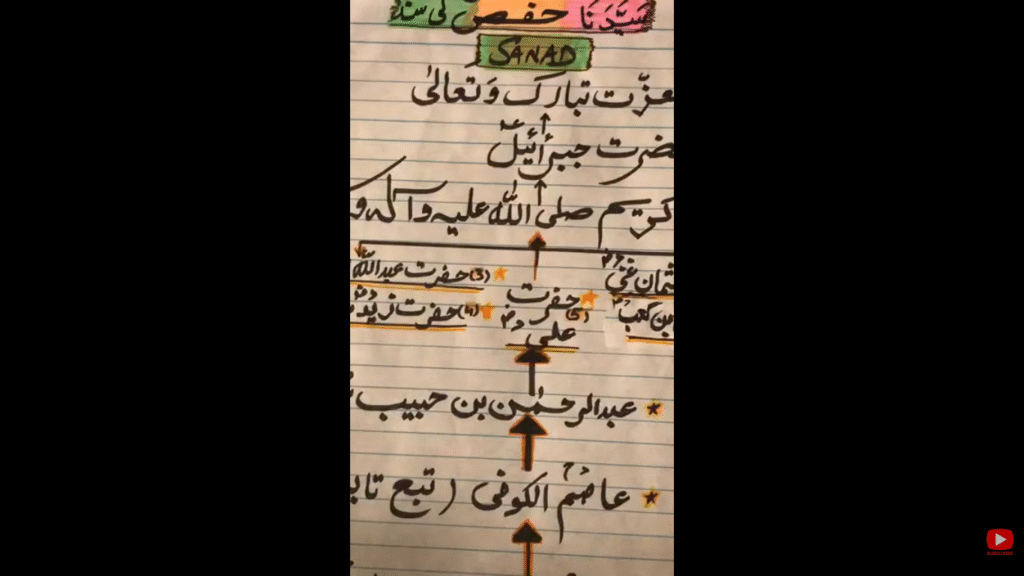
The chain of narration (isnad) for the Hafs ‘an ‘Asim recitation of the Quran traces back to the Prophet Muhammad through the following route:
1. Hafs ibn Sulayman al-Asadi (d. 180 AH)
- Learned the recitation from his teacher and stepfather:
2. ‘Asim ibn Abi al-Najud al-Kufi (d. 127 AH)
- Learned from the following prominent companion of the Prophet:
3. Abu ‘Abd al-Rahman al-Sulami (d. 75 AH)
- He, in turn, learned from the senior companions of the Prophet, including:
- ‘Uthman ibn ‘Affan
- ‘Ali ibn Abi Talib
- ‘Abdullah ibn Mas’ud
- Ubayy ibn Ka’b
This chain of transmission is highly regarded for its precision and reliability, which is a significant reason why the Hafs ‘an ‘Asim recitation is the most widespread in the Muslim world today.
Hafs An Asim | Hafs Al Asim | Hafs Bin Asim
- Hafs An Asim | Hafs Al Asim | Hafs Bin Asim
- Hafs An Asim Tajweed Shatibiyyah
- Imam Hafs An Asim
- Importance Of Riwayat Hafs An Asim Recitation
- Tips For Beginners On How Master Qiraat Hafs An Asim
- Key Features Of Qiraat Hafs An Asim Recitation
- Differences Between Qiraat Hafs An Asim And Other Qiraats
“THE BEST AMONG YOU (MUSLIMS) ARE THOSE WHO LEARN THE QUR’AN AND TEACH IT.”
Welcome to our blog post on the captivating world of Qiraat Hafs an Asim, one of the most renowned and widely recited riwayats in the art of Quranic recitation. If you’re a lover of the melodious recitation of the Quran, then get ready to be captivated by this unique style. Dive into a mesmerizing journey as we unravel the intricacies and beauty behind this unique style, delving into its historical significance, melodious nuances, and the profound impact it has had on millions around the globe.
In this article, we will explore the origins and significance behind Riwayat Hafs an Asim, diving into its rich history and revealing why it continues to resonate with millions around the globe. So sit back, relax, and prepare to embark on a soul-stirring journey through Qiraat Hafs an Asim – a truly remarkable treasure within Islamic culture!
Hafs An Asim Tajweed Shatibiyyah
Qiraat Hafs an Asim is one of the seven canonical recitations of the Quran, known for its melodic style and widespread usage in modern times. It is also referred to as Riwayat Hafs an Asim, named after two prominent figures in the transmission of this recitation – Hafs ibn Sulayman al-Asadi and Asim ibn Abi al-Nujud.
This recitation has a special significance for Muslims as it is one of the most widely used and recognizable styles of Quranic recitation in the world today. Its popularity can be attributed to various reasons, including its beautiful melodies, easy memorization, and strong historical roots.
Imam Hafs An Asim
Imam Hafs ibn Sulayman al-Asadi was a prominent scholar from Kufa who was known for his mastery in Quranic recitation. He studied under many renowned scholars such as Imam Abu Hanifa and Imam Malik before eventually becoming a student of Asim ibn Abi al-Nujud. It was through this chain of transmission that Qiraat Hafs an Asim was passed down to us.
Asim ibn Abi al-Nujud was a well-respected scholar from Medina who had learned directly from several companions of Prophet Muhammad (peace be upon him). He mastered all ten canonical Qiraats (recitations) and chose to transmit Qiraat Hafs an Asim due to its widespread usage and acceptance among the people of Medina.
The significance of Qiraat Hafs an Asim lies not only in its historical roots but also in its preservation and transmission. It is believed that this recitation has been passed down through a continuous chain of narration from the time of Prophet Muhammad (peace be upon him) to the present day, ensuring its authenticity and accuracy.
Moreover, Qiraat Hafs an Asim has been officially adopted by many Muslim countries as their standard recitation for teaching and memorizing the Quran. This has further contributed to its popularity and widespread usage among Muslims worldwide.
Qiraat Hafs an Asim holds great significance in the Islamic world as one of the most widely used and recognized styles of Quranic recitation. Its beautiful melodies, strong historical roots, and widespread acceptance make it a beloved recitation for millions of Muslims around the globe.
Importance Of Riwayat Hafs An Asim Recitation
Understanding the concept of Riwayat is crucial in the world of Quranic recitation. It refers to the transmission and narration of the Quranic text and its proper pronunciation from one generation to another. In simpler terms, it is the chain of narrators who have passed down their knowledge and expertise in reciting the Quran.
The importance of Riwayat can be traced back to Prophet Muhammad (peace be upon him) himself as he was known for teaching his companions not only the words but also the correct way of reciting them. The Prophet (PBUH) received revelation from Angel Jibreel and recited it to his companions, who then memorized and recited it correctly. This practice continued after his passing, with his companions passing on their knowledge to others, creating an unbroken chain of transmission.
Riwayat also ensures that there is a standardization in Quranic recitation across different regions and dialects. It helps maintain consistency in the pronunciation and intonation of certain words, making sure that every Muslim is able to recite the Quran exactly as it was revealed.
There are seven main Riwayat or transmissions recognized by scholars, each tracing its roots back to a specific companion of Prophet Muhammad (PBUH). One such popular riwayat is Hafs an Asim which has been transmitted through Asim ibn Abi al-Najud from Imam Ibn Kathir al-Makki.
One might wonder why there are multiple transmissions when there is only one Quran. This is because during the time of the Prophet (PBUH), different companions would recite the Quran in their own dialects and pronunciation, which was accepted by the Prophet (PBUH). However, after his passing, there was a need for standardization and preservation of the text. Hence, these different transmissions were compiled and preserved to ensure that the original text is not lost or altered.
Moreover, Riwayat also serves as a means of verifying the authenticity of the Quran. With an unbroken chain of transmission, scholars are able to trace back any changes or discrepancies in recitation to its origin and determine its validity.
Understanding Riwayat is essential for every Muslim who wishes to study and recite the Quran. It ensures that we are reciting the words of Allah accurately and following in the footsteps of Prophet Muhammad (PBUH) and his companions. It is a testament to how meticulously the Quran has been preserved over centuries and serves as a reminder that it is our duty to continue this legacy by learning and passing on this knowledge to future generations.
ʿĀṣim ibn Abī al-Najūd (died 745 CE/127 AH), whose kunya (epithet) was Abū Bakr, was a renowned Islamic scholar from Kufa and one of the seven canonical transmitters of the Quranic recitations, or Qira’at. The reading attributed to him, particularly through his student Hafs, is the most common and popular method of reciting the Quran worldwide today.
Key details about his life and legacy:
- Full name and origin: His full name was Abū Bakr ʿĀṣim ibn Bahdala ibn Abī al-Najūd al-Asadī al-Kūfī. He was of Arab descent and belonged to the tribe of Banu Asad.
- Era: As a member of the Tabi’un (the generation after the Prophet’s companions), ʿĀṣim met and narrated traditions from several companions.
- Expertise: He was a master of Quranic recitation (qira’at), known for his beautiful voice, eloquence, and precision. He was also a respected scholar of grammar (nahw) and a reliable narrator of hadith.
- Chain of transmission (Isnad): ʿĀṣim’s method of recitation draws on two prominent chains of transmission from the time of the companions:
- He learned the recitation of Ali ibn Abi Talib from his teacher Abu Abdur-Rahman as-Sulami.
- He learned the recitation of Abdullah ibn Masud from his teacher Zirr ibn Hubaysh.
- Notable students and narrations: His most famous narrators, who passed on his recitation to future generations, were:
- Hafs ibn Sulayman: Hafs transmitted ʿĀṣim’s recitation according to the method of Ali ibn Abi Talib. Today, this is the most widespread and standard form of Quranic recitation.
- Shuʿba ibn Ayyash (also known as Abu Bakr): Shuʿba transmitted ʿĀṣim’s recitation according to the method of Abdullah ibn Masud.
- Prominence in Kufa: After his teacher’s death, ʿĀṣim became the leading authority on recitation in Kufa for over 50 years. Students from far and wide traveled to learn from him.