
Palestine is a de jure sovereign state in the Middle East with a complex history and unresolved conflict with Israel. It is officially the State of Palestine, recognized by 157 UN member states, but its territory is divided and largely under Israeli control.
Geography
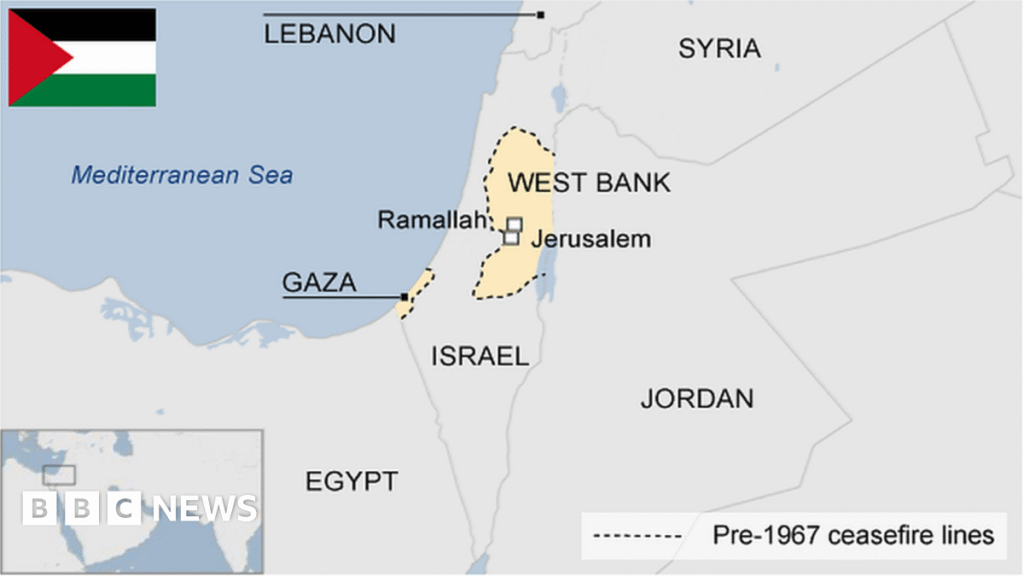
The territory claimed by the State of Palestine is geographically separated into two areas that were captured by Israel in the 1967 Six-Day War:
- West Bank: A landlocked territory bordering Jordan to the east and Israel to the north, south, and west. East Jerusalem is also in the West Bank.
- Gaza Strip: A coastal enclave bordering the Mediterranean Sea to the west, Egypt to the southwest, and Israel to the north and east.
Governance and political status
Palestine has a contested and complex political situation:
- International Recognition: As of September 2025, 157 of 193 UN member states recognize Palestine as a sovereign state. It has “non-member observer state” status at the UN, a designation it received in 2012.
- Political Division: The Palestinian Authority (PA), led by the Fatah party, governs portions of the West Bank. The Gaza Strip has been controlled by the rival Hamas government since 2007.
- Territorial Control: Israel maintains military occupation over the West Bank and Gaza Strip, controls their borders, and has built numerous settlements in the West Bank, which are considered illegal under international law.
- Leadership Change: In February 2024, the entire Palestinian Authority government resigned amid public discontent and international pressure, further complicating unified Palestinian governance.
Recent conflict (2023–present)
The most recent and significant escalation of the Israeli-Palestinian conflict began on October 7, 2023.
- Hamas Attack: Palestinian militant groups, led by Hamas, launched a surprise attack on southern Israel, resulting in the deaths of approximately 1,200 people and the capture of over 250 hostages.
- Israeli Offensive in Gaza: In response, Israel declared war and began a massive military offensive in the Gaza Strip. The assault has resulted in large-scale destruction, tens of thousands of Palestinian casualties, mass displacement, and a humanitarian crisis.
- Regional Repercussions: The conflict has heightened regional tensions, including clashes between Israel and Hezbollah, attacks by Houthi rebels on commercial ships, and direct confrontations between Israel and Iran.
- International Reaction: The war has led to global protests and accusations of war crimes against both Israeli forces and Hamas. In July 2024, the International Court of Justice found Israel’s ongoing presence in the Occupied Palestinian Territories to be illegal.
Historical context
The modern Israeli-Palestinian conflict is rooted in a history of demographic shifts, foreign rule, and competing claims to the land.
- British Mandate (1920–1947): After the Ottoman Empire fell, the British Mandate for Palestine incorporated the Balfour Declaration, which supported a “national home for the Jewish people.” Large-scale Jewish immigration increased tensions with the Arab population.
- 1947 UN Partition Plan: The UN proposed partitioning Palestine into separate Arab and Jewish states. The plan was accepted by Jewish leaders but rejected by Arab leaders.
- 1948 Arab-Israeli War: Following the British withdrawal and the declaration of the State of Israel, war broke out. It resulted in Israel controlling more territory, and the mass displacement of Palestinians, an event known as the Nakba.
- 1967 Six-Day War: Israel captured the West Bank, East Jerusalem, and the Gaza Strip.
- Oslo Accords (1993): Negotiations led to the mutual recognition of Israel and the Palestine Liberation Organization (PLO) and the creation of the Palestinian Authority, intended as a step toward a Palestinian state.