
خيركم من تعلم القرآن وعلمه
Khairukum man ta’allamal Qur’aana wa ‘allamahu (Bukhari)
| Abu ‘AmrḤafṣ ibn Sulaymanal-Asadi al-Kufi | |
|---|---|
| حفص بن سليمان | |
| Personal Life | |
| Born | AD 706 Baghdad, Umayyad Caliphate |
| Died | AD 796 (aged 89–90) Kufa, Abbasid Caliphate |
| Home town | Makkah |
| Parent | Sulayman ibn al-Mughirah ibn Abi Dawud (father) |
| Known for | Transmitting a Qira’at which became the famous riwayat in Arabia, India and even the western counteries |
| Religious life | |
| Religion | Islam |
| Muslim leader | |
| Teacher | Aasim ibn Abi al-Najud |
| StudentsObaid bin Al-Saba | |
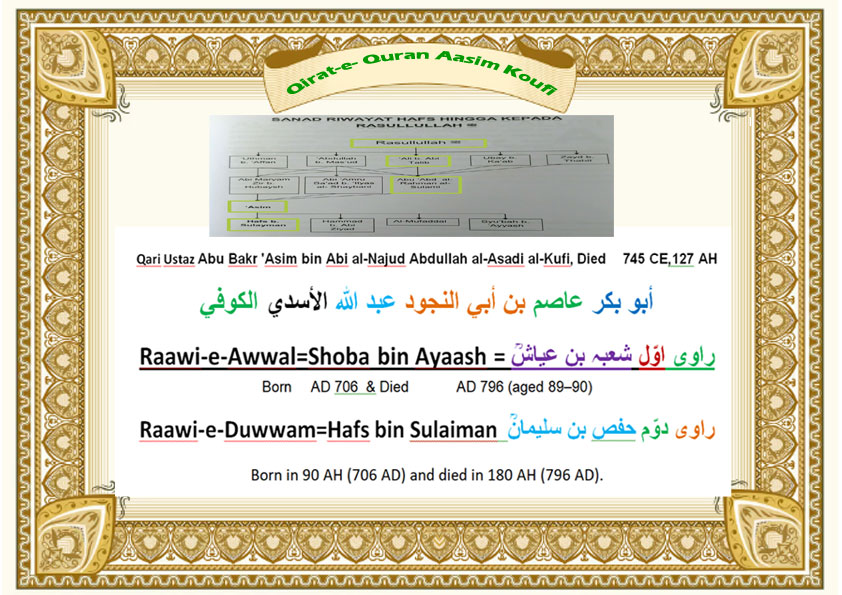
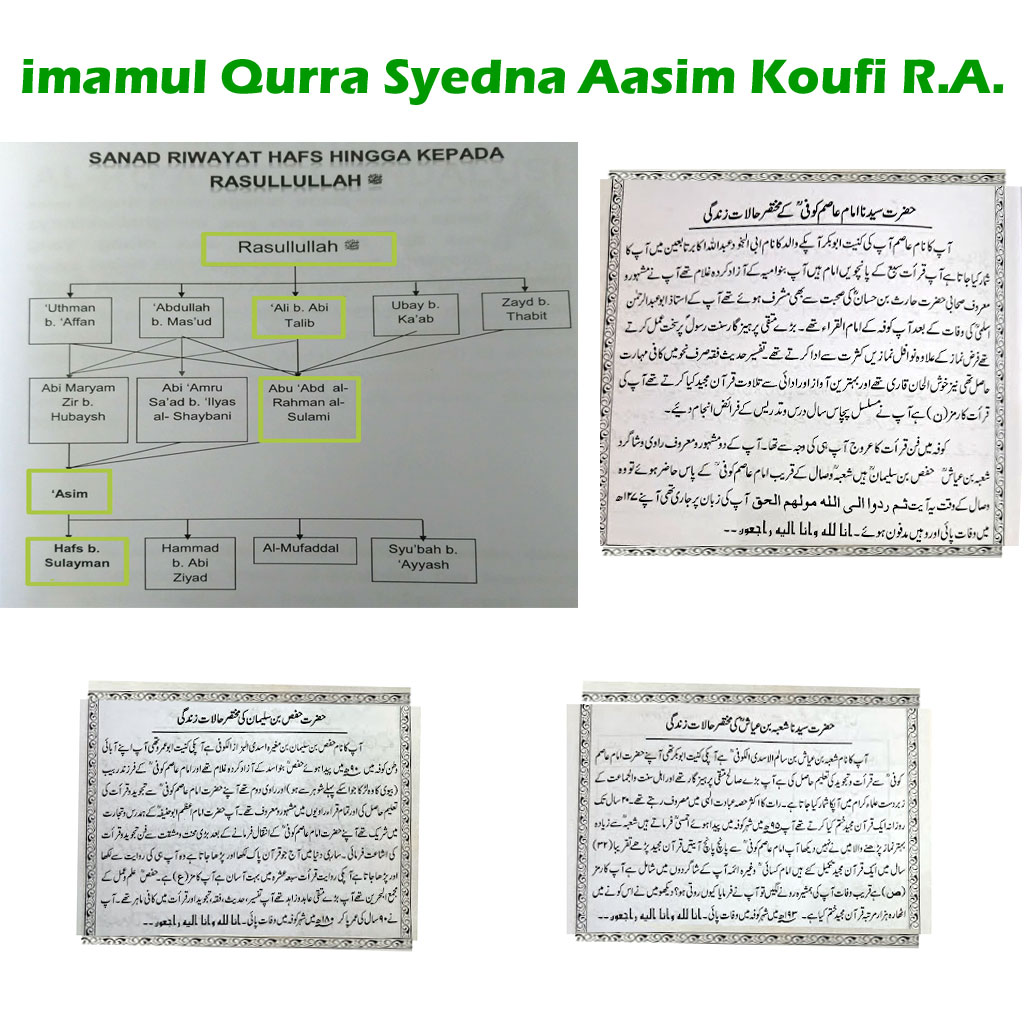
Hafs (Abū ʽAmr Ḥafṣ ibn Sulaymān ibn al-Mughīrah ibn Abi Dawud al-Asadī al-Kūfī, Arabic: أبو عمرو حفص بن سليمان بن المغيرة الأسدي الكوفي, 706–796 AD; 90–180 AH),[1][2] according to Islamic tradition, was one of the primary transmitters of one of the seven canonical methods of Qur’an recitation (qira’at). His method via his teacher Aasim ibn Abi al-Najud has become the most popular method across the majority of the Muslim world.[3]
In addition to being the student of Aasim, Hafs was also his son-in-law.[4] Having been born in Baghdad, Hafs eventually moved to Mecca where he popularized his father-in-law’s recitation method.[4]
Eventually, Hafs’ recitation of Aasim’s method was made the official method of Egypt,[5] having been formally adopted as the standard Egyptian printing of the Qur’an under the auspices of Fuad I of Egypt in 1923.[4] The majority of copies of the Quran today follow the reading of Hafs. In North and West Africa there is a bigger tendency to follow the reading of Warsh.[6]
Hafs recitation

Of all the canonical recitation traditions, only the Kufan tradition of Hafs included the bismillah as a separate verse in Chapter (surah) 1.[7]
In the 10thC, in his Kitāb al-sabʿa fī l-qirāʾāt, Ibn Mujahid mentioned the seven readings of the Quran which originally were all recited by the Prophet of Islam to his followers.[8] Three of their readers hailed from Kufa, a centre of early Islamic learning.[9] The three Kufan readers were Al-Kisa’i, the Kufan; Hamzah az-Zaiyyat; and Aasim ibn Abi al-Najud.
It is, alongside the Hafs ‘an ‘Asim tradition which represents the recitational tradition of Kufa, one of the two major oral transmission of the Quran in the Muslim World.[10] The influential standard Quran of Cairo that was published in 1924 is based on Hafs ‘an ʻAsim’s recitation.
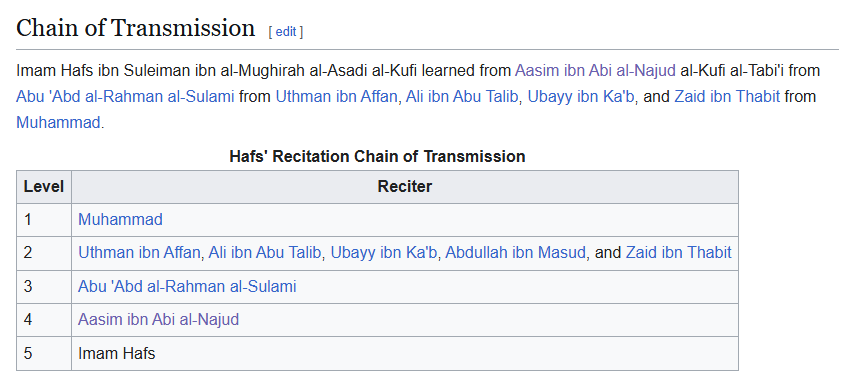
Chain of Transmission
Imam Hafs ibn Suleiman ibn al-Mughirah al-Asadi al-Kufi learned from Aasim ibn Abi al-Najud al-Kufi al-Tabi’i from Abu ‘Abd al-Rahman al-Sulami from Uthman ibn Affan, Ali ibn Abu Talib, Ubayy ibn Ka’b, and Zaid ibn Thabit from Muhammad.
| Level | Reciter |
|---|---|
| 1 | Muhammadﷺ Sallalallahu Alaihi Wa Sallam ( Peace and Mercy of Allah Be Upon him! |
| 2 | Uthman ibn Affan ؓؓ, Ali ibn Abu Talibؓؓ, Ubayy ibn Ka’bؓؓ, Abdullah ibn Masud,ؓؓ and Zaid ibn Thabitؓؓ |
| 3 | Abu ‘Abd al-Rahman al-Sulami ؒ |
| 4 | Aasim ibn Abi al-Najudؒ |
| 5 | Imam Hafsؒ |
Ten readers and transmitters
- Nafi’ al-Madani
- Ibn Kathir al-Makki
- Abu ‘Amr ibn al-‘Ala’
- Ibn Amir ad-Dimashqi
- Aasim ibn Abi al-Najud
- Shu’bah
- Hafs
- Hamzah az-Zaiyyat
- Al-Kisa’i
- Abu Ja’far
- ‘Isa ibn Waddan
- Ibn Jummaz
- Ya’qub al-Yamani
- Ruways
- Rawh
- Khalaf al-Bazzar
- Ishaq
- Idris
References
- Muhammad Ghoniem and MSM Saifullah (8 Jan 2002). “The Ten Readers & Their Transmitters”. Islamic Awareness. Retrieved 11 Apr 2016.
- Shady Hekmat Nasser (2012). “Ibn Mujahid and the Canonization of the Seven Readings”. The Transmission of the Variant Readings of the Qur’an: The Problem of Tawaatur and the Emergence of Shawaadhdh. Leiden: Brill Publishers. p. 129. ISBN 9789004240810.
- Bewley, Aishah. “The Seven Qira’at of the Qur’an” Archived 2006-05-01 at the Wayback Machine, Aisha Bewley’s Islamic Home Page
- Peter G. Riddell, Early Malay Qur’anic exegical activity, p. 164. Taken from Islam and the Malay-Indonesian World: Transmission and Responses. London: C. Hurst & Co., 2001. ISBN 9781850653363
- Cyril Glasse, The New Encyclopedia of Islam, p. 268. Intr. by Huston Smith. Lanham: Rowman & Littlefield, 2003. ISBN 9780759101906
- Aisha Geissinger, Gender and Muslim Constructions of Exegetical Authority: A Rereading of the Classical Genre of Qurʾān Commentary, pg. 79. Leiden: Brill Publishers, 2015. ISBN 9789004294448
- Stefan Wild, Al-Baydawi. Quran: an Encyclopedia
- “Sahih Muslim 819a – The Book of Prayer – Travellers – كتاب صلاة المسافرين وقصرها – Sunnah.com – Sayings and Teachings of Prophet Muhammad (صلى الله عليه و سلم)”. sunnah.com.
- Dutton, Yasin (2012). “Orality, Literacy and the ‘Seven Aḥruf’ Ḥadīth”. Journal of Islamic Studies. 23 (1): 1–49. doi:10.1093/jis/etr092. ISSN 0955-2340. JSTOR 26201011.
- Ibn Warraq, Which Koran? Variants, Manuscript, Linguistics, pg. 45. Prometheus Books, 2011. ISBN 1591024307