
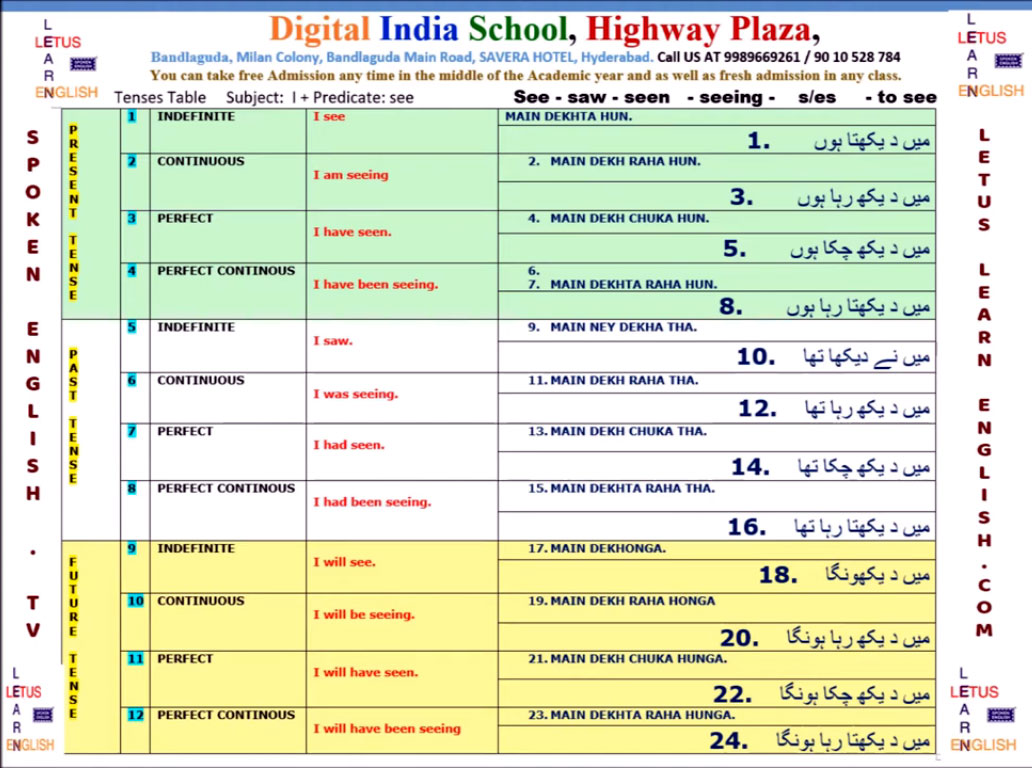


PLEASE MAKE 1 SET OF SENTENCES USING THIS TENSES CHART PROVIDED TO YOU
Based on the tenses chart provided in the file tenseschar-mamajeed-1024×762.jpg, here is a complete set of sentences following all 12 English tenses listed in the table, using the subject “I” and the predicate “see“.
Present Tense
- Indefinite: I see.
- Continuous: I am seeing.
- Perfect: I have seen.
- Perfect Continuous: I have been seeing.
Past Tense
- Indefinite: I saw.
- Continuous: I was seeing.
- Perfect: I had seen.
- Perfect Continuous: I had been seeing.
Future Tense
- Indefinite: I will see.
- Continuous: I will be seeing.
- Perfect: I will have seen.
- Perfect Continuous: I will have been seeing.
KINDLY TRANSLATE IT INTO URDU
Based on the tenses chart provided in the file tenseschar-mamajeed-1024×762.jpg, here is the Urdu translation of the sentences (matching the Roman Urdu and Urdu script given in the table):
Present Tense (زمانہ حال)
- Indefinite: I see.
- Urdu: میں دیکھتا ہوں۔ (Main dekhta hun.)
- Continuous: I am seeing.
- Urdu: میں دیکھ رہا ہوں۔ (Main dekh raha hun.)
- Perfect: I have seen.
- Urdu: میں دیکھ چکا ہوں۔ (Main dekh chuka hun.)
- Perfect Continuous: I have been seeing.
- Urdu: میں دیکھتا رہا ہوں۔ (Main dekhta raha hun.)
Past Tense (زمانہ ماضی)
- Indefinite: I saw.
- Urdu: میں نے دیکھا تھا۔ (Main ney dekha tha.)
- Continuous: I was seeing.
- Urdu: میں دیکھ رہا تھا۔ (Main dekh raha tha.)
- Perfect: I had seen.
- Urdu: میں دیکھ چکا تھا۔ (Main dekh chuka tha.)
- Perfect Continuous: I had been seeing.
- Urdu: میں دیکھتا رہا تھا۔ (Main dekhta raha tha.)
Future Tense (زمانہ مستقبل)
- Indefinite: I will see.
- Urdu: میں دیکھوں گا۔ (Main dekhonga.)
- Continuous: I will be seeing.
- Urdu: میں دیکھ رہا ہوں گا۔ (Main dekh raha honga.)
- Perfect: I will have seen.
- Urdu: میں دیکھ چکا ہوں گا۔ (Main dekh chuka hunga.)
- Perfect Continuous: I will have been seeing.
- Urdu: میں دیکھتا رہا ہوں گا۔ (Main dekhta raha hunga.)
KINDLY TRANSLATE IT TO HINDI
Based on the tenses chart provided in the file tenseschar-mamajeed-1024×762.jpg, here is the translation of the sentences into Hindi (using Devanagari script and Latin transliteration) to match the exact pronunciations and meanings shown in the table:
Present Tense (वर्तमान काल)
- Indefinite: I see.
- Hindi: मैं देखता हूँ। (Main dekhta hun.)
- Continuous: I am seeing.
- Hindi: मैं देख रहा हूँ। (Main dekh raha hun.)
- Perfect: I have seen.
- Hindi: मैं देख चुका हूँ। (Main dekh chuka hun.)
- Perfect Continuous: I have been seeing.
- Hindi: मैं देखता रहा हूँ। (Main dekhta raha hun.)
Past Tense (भूतकाल)
- Indefinite: I saw.
- Hindi: मैंने देखा था। (Main ne dekha tha.)
- Continuous: I was seeing.
- Hindi: मैं देख रहा था। (Main dekh raha tha.)
- Perfect: I had seen.
- Hindi: मैं देख चुका था। (Main dekh chuka tha.)
- Perfect Continuous: I had been seeing.
- Hindi: मैं देखता रहा था। (Main dekhta raha tha.)
Future Tense (भविष्य काल)
- Indefinite: I will see.
- Hindi: मैं देखूँगा। (Main dekhunga.)
- Continuous: I will be seeing.
- Hindi: मैं देख रहा हूँगा। (Main dekh raha honga.)
- Perfect: I will have seen.
- Hindi: मैं देख चुका हूँगा। (Main dekh chuka hunga.)
- Perfect Continuous: I will have been seeing.
- Hindi: मैं देखता रहा हूँगा। (Main dekhta raha hunga.)
KINDLY TRANSLATE IT TO TELUGU
Based on the structure of the English sentences and their meanings derived from the tenses chart in the file tenseschar-mamajeed-1024×762.jpg, here is the translation into Telugu (using Telugu script and Latin transliteration):
Present Tense (వర్తమాన కాలం)
- Indefinite: I see.
- Telugu: నేను చూస్తాను. (Nenu chusthanu.)
- Continuous: I am seeing.
- Telugu: నేను చూస్తున్నాను. (Nenu chusthunnanu.)
- Perfect: I have seen.
- Telugu: నేను చూశాను / నేను చూసి ఉన్నాను. (Nenu chushanu / Nenu chusi unnanu.)
- Perfect Continuous: I have been seeing.
- Telugu: నేను చూస్తూనే ఉన్నాను. (Nenu chusthune unnanu.)
Past Tense (భూత కాలం)
- Indefinite: I saw.
- Telugu: నేను చూశాను. (Nenu chushanu.)
- Continuous: I was seeing.
- Telugu: నేను చూస్తూ ఉన్నాను. (Nenu chusthu unnanu.)
- Perfect: I had seen.
- Telugu: నేను అప్పటికే చూసి ఉన్నాను. (Nenu appatike chusi unnanu.)
- Perfect Continuous: I had been seeing.
- Telugu: నేను చూస్తూనే ఉంటిని. (Nenu chusthune uhntini.)
Future Tense (భవిష్యత్ కాలం)
- Indefinite: I will see.
- Telugu: నేను చూస్తాను. (Nenu chusthanu.)
- Continuous: I will be seeing.
- Telugu: నేను చూస్తూ ఉంటాను. (Nenu chusthu untanu.)
- Perfect: I will have seen.
- Telugu: నేను చూసి ఉంటాను. (Nenu chusi untanu.)
- Perfect Continuous: I will have been seeing.
- Telugu: నేను చూస్తూనే ఉంటాను. (Nenu chusthune untanu.)